
Oracle Fusion General Ledger vs Subledger Accounting: What’s the Difference?

Author
Tech Leads IT
Our Happy Students
Follow us on


Sometimes, an invoice approved in Payables may not appear in the General Ledger. This can happen because the accounting hasn’t been created yet. Approving an invoice and creating accounting are two separate steps, and understanding this difference is important when working with Oracle Fusion Financials.
This article explains Oracle Fusion General Ledger (GL) vs. Subledger Accounting (SLA): what each one does, how transactions travel between them, and which one you configure first. This guide directly answers what separates General Ledger from Subledger Accounting, how data flows from Payables and Receivables into the ledger, and why transactions sometimes seem to vanish between the two.
What Is the Difference Between General Ledger and Subledger Accounting in Oracle Fusion?
Oracle Fusion General Ledger is the central book of record where all journal entries are summarized, balanced, and reported. Subledger Accounting is the rule-based engine that converts transactions from Payables, Receivables, Assets, and other subledgers into accounting entries before they reach the General Ledger. GL holds the totals. SLA decides how each transaction gets its debits and credits.
Think of a restaurant. The kitchen tickets, the card machine slips, and the supplier invoices are the subledgers. The owner’s monthly profit-and-loss statement is the General Ledger. Nobody hands the owner a pile of tickets and says “figure it out.” Someone first decides how each type of paper turns into a bookkeeping entry: this sale goes to food revenue, that delivery goes to cost of goods. In Oracle Fusion, Subledger Accounting is that someone.
Here is the practical split. General Ledger handles the ledger itself, which includes the chart of accounts, the accounting calendar, currencies, journal posting, period close, and financial reporting. Subledger Accounting handles the translation layer, which includes accounting rules, journal entry rules, and mapping sets that decide which accounts a given transaction should hit.
The common problem takes place in many cases where Oracle Fusion is installed. Groups that can distinguish between Payables and the General Ledger will solve the problem fast, whereas other groups waste several hours investigating different screens that are not related to this situation at all. For instance, during the month-end closure procedure, the amount of accruals in the General Ledger might seem smaller than it should be. The reason for this problem might not be the General Ledger itself. Invoices might already be validated in Payables, but accounting is not created because the create accounting procedure was not performed. Once this process is performed successfully, then postings can be sent to the GL.
How Does Data Flow from the Subledgers into the General Ledger?
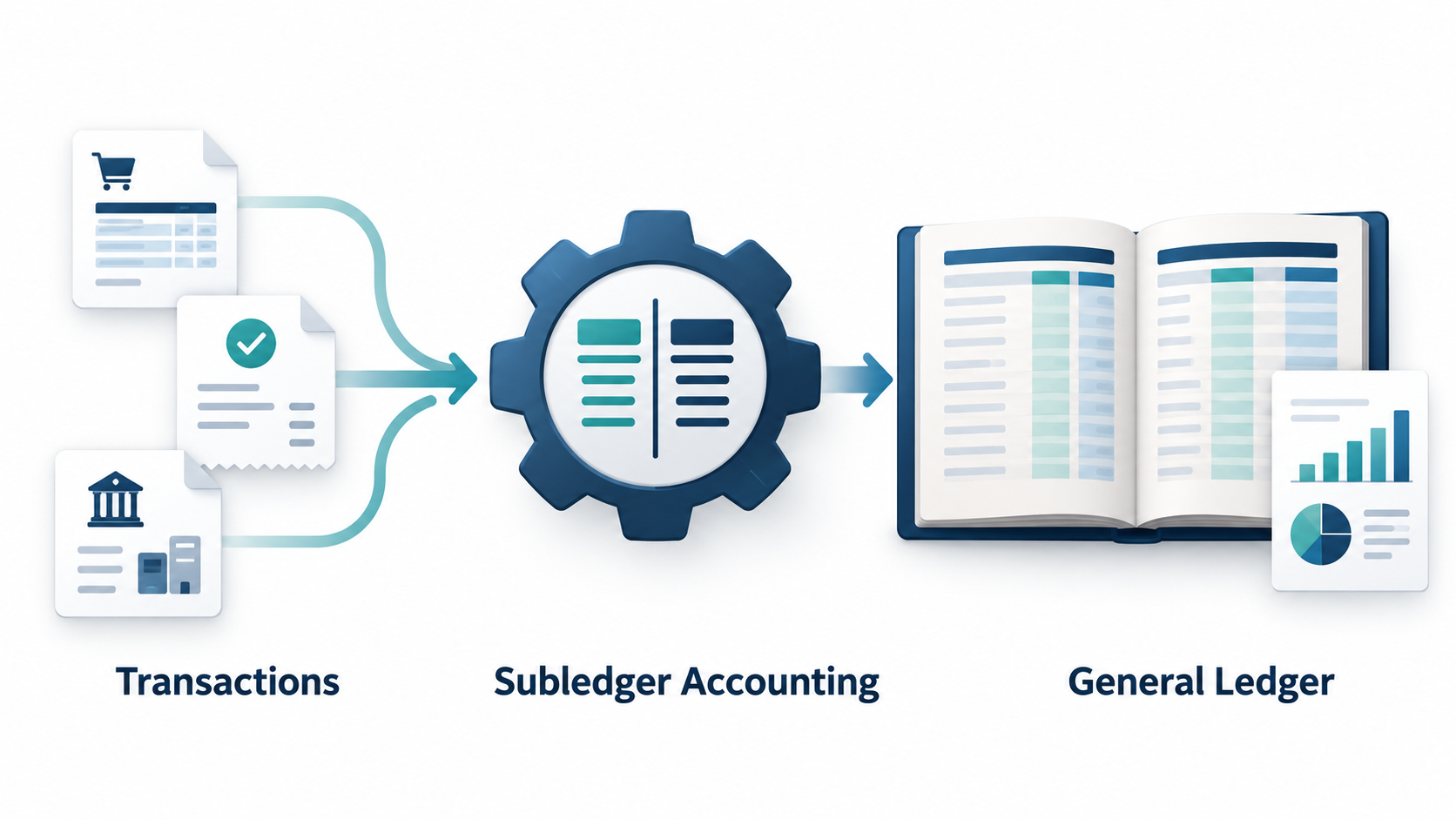
Data flows in a fixed sequence in Oracle Fusion. A business event occurs in a subledger, such as an approved payables invoice. The Create Accounting process then generates subledger journal entries using SLA rules. Those entries transfer to the General Ledger as journals, and a user or scheduled job posts them to update account balances.
The sequence matters because each step can stop on its own. An invoice can be approved but not accounted. It can be accounted but not transferred. It can be transferred but not posted. When someone says “my transaction isn’t in the ledger,” the first question is always which of those stages it reached.
Here is the flow in order:
- Transaction event. A user validates an invoice, confirms a receipt, or capitalizes an asset.
- Create Accounting. The SLA engine applies your rules and produces subledger journal entries in Draft or Final status.
- Transfer to General Ledger. Final entries move into the GL interface and become journals.
- Post. The journals update balances and become visible in financial reports.
Does your team know which of these steps run automatically and which needs a manual trigger? In many Fusion environments, a scheduled job runs Create Accounting and the transfer together, but I have seen clients where nobody scheduled it. Entries then sat in the subledger for a whole period.
Draft accounting deserves a special mention. When you run Create Accounting in Draft mode, Oracle builds the entries for review without making them final. Draft entries cannot transfer to the ledger. They exist so accountants can check the rules before committing. A 400-person retail client used draft mode during their first parallel run and caught a mapping error that would have posted freight costs to the wrong expense account across roughly 2,000 invoices. Fixing a rule before final accounting takes minutes. Reversing posted journals takes days.
One more point on drill-down. Because SLA keeps the link between each ledger journal line and its source transaction, an auditor can start at a GL balance and drill down through the subledger entry to the original invoice. That audit trail is a major reason Oracle separates the two layers rather than letting subledgers write straight to the ledger.
What Does Subledger Accounting Actually Do in Oracle Fusion Financials?
Subledger Accounting applies configurable rules to transform subledger transactions into accounting entries. Instead of hard-coding which accounts a transaction hits, SLA lets your team define accounting methods, journal line rules, account rules, and mapping sets, so different ledgers or legal requirements can account for the same transaction in different ways.
Here are the building blocks, explained one at a time.
An accounting method (technically a Subledger Accounting Method) is the master bundle. You attach it to a ledger, and it tells Oracle which set of rules to use for each subledger application. Oracle ships with seeded methods, and many clients start there.
Journal line rules define what lines a journal gets. For a payables invoice, a typical rule creates an expense debit and a liability credit, with tax lines when applicable.
Account rules decide which account hits those lines. A rule might say “use the expense account from the invoice distribution,” or “take the cost center from the requester and combine it with a fixed natural account.” Mapping sets are lookup tables that translate one value into another, such as converting a project type into a revenue account.
A 3,000-person financial services client needed the same invoices accounted differently in their primary ledger and a secondary ledger kept for another reporting standard. SLA handled it without a custom line of code. If we attach one accounting method to the primary ledger and a different one to the secondary. Both generate entries from the same transaction at the same time. That flexibility is the real purpose of the layer.
What happens if you skip SLA customization entirely? For many clients, nothing bad. The seeded rules work fine for straightforward accounting. You customize when the business needs something the defaults don’t give you, like deriving cost centers from a custom field or splitting one transaction across several accounts by percentage.
Do I Configure General Ledger or Subledger Accounting First?
Configure General Ledger first. The ledger, chart of accounts, accounting calendar, and currency must exist before Subledger Accounting can attach an accounting method to anything. After the ledger is defined, you review or customize SLA, then set up subledgers like Payables and Receivables on top.
Oracle’s own Accounting Configuration Manager frames this around four elements that define a ledger: the chart of accounts, the accounting calendar, the primary currency, and the subledger accounting method. Notice that the accounting method is one of the four. You pick it while defining the ledger, so you need at least a seeded method available early.
For a 2,500-person manufacturing client implementation, the following order:
- Define the chart of accounts structure and value sets.
- Build the accounting calendar and currencies.
- Create the ledger and assign the subledger accounting method.
- Configure Payables, Receivables, and Assets against that ledger.
- Customize SLA rules only where testing showed a real gap.
What’s the most common mistake here? Teams reverse steps 3 and 4. They begin configuring Payables, hit a ledger dependency, and have to back up. It costs a day or two each time, which adds up on a six-week timeline.
If this setup order matches the project you’re about to start, Oracle Fusion Financials training program walks through it hands-on, using a practice ledger that you build from an empty instance. No prior Fusion experience is needed. Over 1,200 professionals have trained with TechLeads IT across 12 batches.
Here is a quick reference you can keep beside you:
| Question | General Ledger | Subledger Accounting |
| What is it? | Central book of record | Rule engine that creates accounting |
| What does it hold? | Journals, balances, period status | Subledger journal entries and rules |
| Who typically owns it? | GL accountant, controller | Subledger accountant, functional consultant |
| When do you touch it? | Journals, reports, period close | Rules, mappings, Create Accounting |
| What breaks if it’s wrong? | Balances and reports | Account derivation and transfers |
| Setup order | First | After the ledger exists |
Why Don’t My Subledger Transactions Show Up in the General Ledger?
Subledger transactions usually fail to appear in the General Ledger because they stopped at one of three stages: accounting was never created, entries were created in Draft status, or entries were created but not transferred or posted. Checking the transaction’s accounting status in the subledger tells you which stage it stopped at.
Start with the transaction. Open the invoice or receipt and look at its accounting status. If it says Unaccounted, run Create Accounting. If it shows accounted but the journal isn’t in the ledger, check whether the entry is Final and whether the transfer job ran. If a journal appears in the ledger but not in your report, look at whether it’s still unposted.
The Create Accounting Execution Report is your best friend here. It lists every transaction that failed accounting and gives a reason, such as a missing account, a closed period, or an invalid code combination. Closed periods trip up more teams than any other cause. If the GL period is closed or not yet open when you try to account a transaction, it will not create an entry in that period.
How often do you check this report? Every month-end, I’d say, and ideally every week. A 600-person distribution client scheduled it daily after a go-live where 340 invoices had quietly failed accounting because of one bad account derivation. The error count dropped to near zero within a month, since the team saw failures while they were still small.
I should name one honest limitation. Error messages in the accounting process can be cryptic when an account rule fails deep inside a nested mapping set. The report tells you which transaction failed but not always which rule line caused it. We need to work around this by testing new rules on a small batch in Draft mode first, and by naming rules clearly so the failing one is easy to spot.
Common Misconceptions About Oracle Fusion General Ledger and Subledger Accounting
Several myths come up in every training batch I run. Clearing them early saves real confusion.
Misconception: Subledger Accounting is optional, so you can skip it.
Reality: SLA is not an add-on module. Every transaction from a subledger passes through it on the way to the ledger, even if you use only seeded rules. You can skip customizing it, but you can’t skip it.Why it matters: Beginners who think SLA is optional never learn where account derivation happens, and they can’t debug wrong accounts.
Misconception: If an invoice is validated, it’s in the General Ledger.
Reality: Validation is a Payables status. Accounting, transfer, and posting are three separate steps that follow it. Why it matters: Finance teams that assume validation equals ledger impact will report incorrect liability numbers at month-end.
Misconception: Manual journals also go through Subledger Accounting.
Reality: Journals entered directly in the General Ledger, whether manual or uploaded through a spreadsheet, bypass SLA. Only subledger-originated transactions use it.Why it matters: When you drill down from a manual journal line, you won’t find a subledger source, and that’s expected behavior, not a bug.
If these distinctions are exactly where your team gets stuck, the Oracle Fusion General Ledger and SLA workshop covers each one with live exercises, including a deliberate “broken” setup where you find why entries fail to transfer
Frequently Asked Questions
Q: What does Oracle Fusion Subledger Accounting actually do in simple terms?
A: Subledger Accounting converts transactions from modules like Payables and Receivables into debit and credit journal entries using rules you can configure. It sits between the subledger and the General Ledger, so every journal in your ledger can be traced back to its source transaction for audit purposes.
Q: Do I need to customize Subledger Accounting rules for every implementation?
A: No. Oracle ships seeded accounting methods that cover standard scenarios, and many implementations run on them with little or no change. You customize only when your business needs something the seeded rules can’t produce, like deriving a segment from a custom field or accounting the same transaction differently in two ledgers.
Q: Why is my Payables invoice validated but missing from the General Ledger?
A: Validation only confirms the invoice is correct in Payables. The entry reaches the ledger after Create Accounting runs; the entry transfers to the General Ledger, and the journal is posted. Check the invoice’s accounting status first, then the Create Accounting Execution Report for any errors blocking the process.
Q: What is the difference between Draft and Final accounting in Oracle Fusion?
A: Draft accounting builds subledger journal entries for review but cannot transfer to General Ledger, so it’s useful for testing rules. Final accounting makes the entries official and eligible to transfer. Use Draft while testing new rules and Final once you’re confident the accounts are derived correctly.
Q: Can one transaction be accounted for differently in a primary and a secondary ledger?
A: Yes. Each ledger can use its own subledger accounting method, so the same transaction can produce different journal entries in each ledger. This is how organizations maintain books under more than one reporting standard without entering transactions twice.
Conclusion
General Ledger holds the totals. Subledger Accounting decides how each transaction earns its place in them. Once you can name the stage a transaction stopped at, whether unaccounted, draft, untransferred, or unposted, most “missing journal” mysteries solve themselves in a few minutes.
Over 1,200 professionals have trained with TechLeads IT across 12 batches, and many came in confused by exactly this topic. The next batch starts soon. Early registration saves 10% off the standard rate.
Categories
Trending Blogs
Get Notified about Latest Blogs, Interview Questions & Job Alerts
Stay updated with the latest insights, trends, and expert tips on Oracle Fusion SCM. Subscribe to our newsletter and never miss an update!
Explore Our Related Blogs
0
LikesConnect with us


Subscribe







© Copyright Tech Leads IT. All Rights Reserved
Stay Connected with us


