
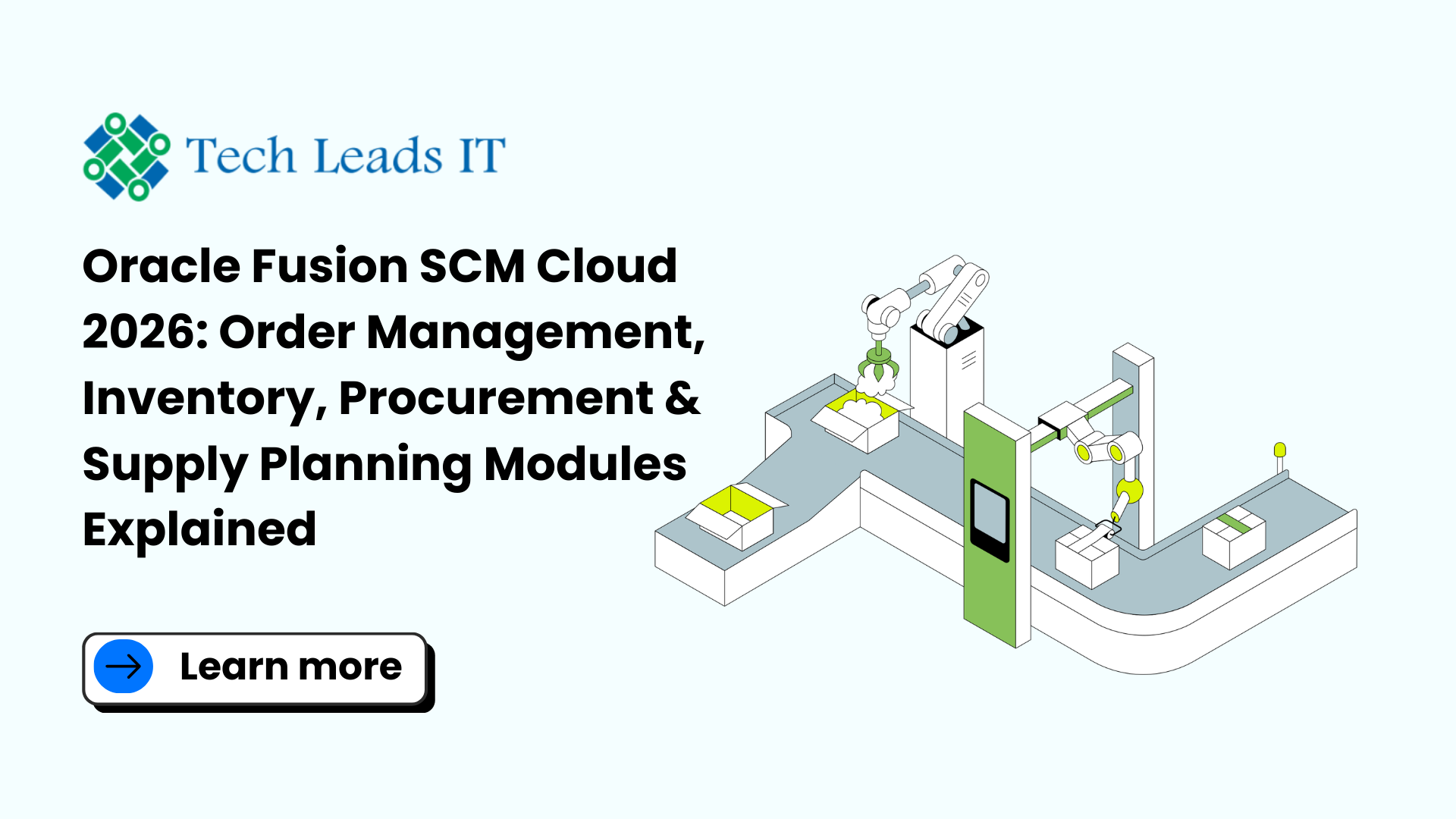
Oracle Fusion SCM Cloud 2026 Order Management, Inventory, Procurement & Supply Planning Modules Explained

Author
TechLead IT
Our Happy Students
Follow us on


Quick Answer
Oracle Fusion SCM Cloud in 2026 includes four core functional modules: Order Management, Inventory Management, Procurement, and Supply Chain Planning. These modules work together on a single unified cloud platform to help organizations automate their end-to-end supply chain — from purchase requisition to customer delivery. Techleads IT offers hands-on training programs for each of these modules, designed specifically for SCM Functional Consultants and ERP professionals in India and globally.
Table of Contents
- What Is Oracle Fusion SCM Cloud?
- Why Oracle SCM Cloud Still Matters in 2026
- Module 1: Oracle Order Management Cloud
- Module 2: Oracle Inventory Management Cloud
- Module 3: Oracle Procurement Cloud
- Module 4: Oracle Supply Chain Planning Cloud
- How These Modules Connect — The Full Picture
- Career Scope for Oracle SCM Consultants in 2026
- FAQ: Oracle Fusion SCM Cloud Modules
What Is Oracle Fusion SCM Cloud?
Oracle Fusion SCM Cloud is Oracle's enterprise-grade, cloud-native supply chain management suite. It's part of the broader Oracle Cloud ERP and SCM portfolio — and it's genuinely one of the most comprehensive solutions out there for large and mid-size organizations managing complex supply chains.
At Techleads IT, we've trained hundreds of SCM Functional Consultants, Oracle ERP consultants, and fresh IT graduates who wanted to build a career in Oracle Cloud implementations. And one thing we hear again and again from our learners: "I didn't realize how deeply these modules are connected until I started working on a real project."
That's exactly what this guide is about. Not just listing features. Actually explaining how these modules work, what they do in practice, and why they matter for your career in 2026.
Why Oracle SCM Cloud Still Matters in 2026
Let's be direct. The Oracle SCM market is not shrinking — it's expanding. According to recent industry data, Oracle Cloud Applications grew revenue by over 20% year-over-year in FY2024. Indian IT services companies like TCS, Infosys, Wipro, and HCL are actively staffing Oracle Fusion SCM Cloud projects across the US, Europe, and APAC regions.
If you're an experienced Oracle SCM consultant or an ERP professional looking to upskill, the demand for certified Oracle Fusion SCM Cloud knowledge in 2026 is real and well-paying.
Some hard numbers to frame this:
- Oracle Fusion SCM implementations are projected to grow 18–22% CAGR through 2027
- Oracle SCM Cloud consultants in India command ₹12–25 LPA at mid-level
- In the US and UK markets, experienced Oracle Order Management or Procurement Cloud consultants earn $90,000–$140,000 annually
The four modules we're covering today — Order Management, Inventory Management, Procurement, and Supply Chain Planning — are the most in-demand specializations within the Oracle Fusion SCM Cloud ecosystem.
Module 1: Oracle Order Management Cloud
What It Does
Oracle Order Management Cloud (OM Cloud) is the customer-facing end of Oracle's SCM suite. It handles the complete Order-to-Cash (O2C) cycle — from the moment a customer places an order to the point when it's fulfilled, shipped, and invoiced.
Think of it this way: a sales rep creates a sales order in Oracle OM. That order needs to be validated, priced, available-to-promise (ATP) checked, picked from a warehouse, shipped, and then billed. Oracle Order Management Cloud orchestrates all of that.
Key Features in 2026:
- Order Orchestration and Fulfillment: One of the standout capabilities is the Order Management Orchestration Engine. It uses fulfillment lines and fulfillment tasks to route orders intelligently — whether the goods are shipping from a warehouse, being drop-shipped from a supplier, or being configured to order (CTO).
- Pricing Engine: Oracle's Advanced Pricing module within OM lets consultants configure complex pricing rules — price lists, discount schedules, promotional pricing, and customer-specific agreements. This is an area that trips up a lot of newer consultants during implementation.
- Available-to-Promise (ATP): The Global Order Promising (GOP) engine checks real-time inventory availability across multiple warehouses and sourcing rules. In a large MNC environment, this alone can make or break delivery performance.
- Extensibility with Oracle Configure, Price, Quote (CPQ): Many 2026 implementations integrate Oracle CPQ Cloud with OM Cloud to support configure-to-order products. If you're specializing in OM, understanding the CPQ-OM integration is a differentiator.
What Consultants Work On
In a real project, an Oracle SCM Order Management consultant typically handles:
- Setting up order types and order transaction types
- Configuring processing constraints
- Building fulfillment rules and sourcing rules
- Setting up customer profiles and payment terms
- Integration with Oracle AR (Accounts Receivable) for invoicing
- Integration with Oracle WMS (Warehouse Management) for fulfillment
A Quick Story from the Field
One of our trainers at Techleads IT — Ramesh, who's worked on Oracle implementations across five MNC clients in the US and India — shared something during a recent batch session. He said on his first project, he spent three days debugging why orders weren't getting past the "Awaiting Shipping" status. Turned out, the sourcing rule was pointing to a ship-from org that wasn't active. Three days. Because nobody had activated the inventory organization properly.
That kind of thing doesn't get mentioned in documentation. It's the real-world stuff that matters. And it's exactly why practical, hands-on oracle scm cloud order management training is so valuable before stepping into a live project.
Module 2: Oracle Inventory Management Cloud
What It Does
Oracle Inventory Management Cloud (INV Cloud) is the backbone of Oracle's SCM suite. Every transaction — whether it's a purchase receipt, a sales shipment, an internal transfer, or a work order completion — touches Inventory.
It manages the physical and logical movement of goods across your organization's supply chain network.
Key Features in 2026:
- Inventory Organizations and Sub-inventories: The organizational hierarchy in Oracle INV is crucial. Items exist within inventory organizations, which map to physical warehouses or storage locations. Within each org, sub-inventories and locators define where exactly stock is stored.
- Item Master and Item Attributes: The Item Master in Oracle Product Hub (which feeds into INV) is one of the most complex setups in any Oracle Fusion SCM implementation. Getting item attributes, units of measure (UOM), and lot/serial number control right from the start saves enormous rework downstream.
- Cycle Counting and Physical Inventory: Oracle Fusion INV Cloud supports both cycle counting (ongoing, tag-based counting) and full physical inventory counts. For any oracle fusion inventory management course worth its name, this is a non-negotiable topic.
- Consignment Inventory: Managing supplier-owned stock that's physically at your location — consignment inventory tracking — is a feature many mid-to-large manufacturers use heavily. It's well-supported in Oracle INV Cloud.
- Material Transactions and Transaction Types: Miscellaneous receipts, miscellaneous issues, subinventory transfers, inter-org transfers — these transaction types are the daily bread of an inventory consultant.
- Min-Max Planning within INV: While full supply planning sits in a separate module, Oracle INV supports basic min-max replenishment planning natively. Good to know for SMB implementations that don't use the full Planning module.
Costing Integration
Oracle Inventory Cloud tightly integrates with Oracle Cost Management. Whether you're using Standard Costing, Actual Costing, or FIFO costing, the cost layer gets updated every time an inventory transaction fires. This is a topic where Oracle SCM Functional Consultants often need deeper finance knowledge.
What Consultants Work On
- Item setup and item organization assignments
- Subinventory and locator configuration
- Transaction type setup and transaction source types
- Lot and serial number attribute setup
- Inter-org shipping networks
- Cycle count class setup and scheduling
- Integration with Oracle WMS, Manufacturing, and Cost Management
Module 3: Oracle Procurement Cloud
What It Does
Oracle Procurement Cloud covers the complete Procure-to-Pay (P2P) cycle. It starts from identifying a need (requisition), goes through sourcing and supplier negotiation, purchase order creation, goods receipt, invoice matching, and finally payment.
It's broken into several functional sub-modules:
Sub-Modules Within Oracle Procurement Cloud
- Oracle Purchasing: The core PO management tool. It handles purchase orders, blanket purchase agreements (BPAs), contract purchase agreements (CPAs), and planned purchase orders. Any oracle procurement cloud modules training must start here.
- Oracle Self Service Procurement (iProcurement): Lets employees raise purchase requisitions through a shopping cart–style interface — either from internal catalogs or from supplier punchout catalogs. Reducing maverick spend is one of the primary business cases for this sub-module.
- Oracle Sourcing: Manages the RFQ (Request for Quotation), RFP, and auction processes. Suppliers can respond online. It's deeply integrated with Oracle Supplier Qualification Management (SQM).
- Oracle Supplier Portal: Suppliers access this portal to view POs, submit invoices, update their profiles, and respond to negotiations. It reduces manual supplier communication overhead significantly.
- Oracle Spend Classification: Uses AI/ML to automatically categorize spend data — a 2024–2026 enhancement that's getting attention from CFOs and CPOs globally.
- Oracle Procurement Contracts: Manages contract authoring, approval, and compliance. Links to POs to ensure purchasing happens within agreed contract terms.
Key 2026 Enhancements
Oracle has been aggressive with AI-assisted procurement in its 2024 and 2025 release updates. In 2026, you'll see:
- AI-powered supplier risk scoring integrated natively
- Automated PO amendment suggestions based on market data
- Smart spend analytics using embedded Oracle Analytics Cloud dashboards
What Consultants Work On
- Procurement agent assignments and business unit setup
- Document styles for POs and BPAs
- Approval workflow configuration (using BPM worklist)
- Supplier setup, supplier sites, and supplier profile management
- Receiving parameters and receiving routing (direct delivery vs. standard receipt vs. inspection required)
- Invoice match options (2-way, 3-way, 4-way matching)
- Catalog setup and punchout catalog integration
The Approval Workflow Challenge
If there's one area where even experienced Oracle Procurement Cloud consultants struggle, it's BPM-based approval workflows. They're powerful, but the configuration UI is not the most intuitive. We've seen projects where approval workflow misconfiguration alone pushed go-live back by two weeks. If you're taking up oracle procurement cloud modules training, make sure the program spends dedicated time on BPM Worklist and Approval Groups.
Module 4: Oracle Supply Chain Planning Cloud
What It Does
Oracle Supply Chain Planning (SCP) Cloud is where strategic intelligence meets operational execution. It helps organizations answer the fundamental supply chain questions:
- How much do we need to produce or procure?
- When do we need it?
- Where should it come from?
- What's the impact of disruption on our plan?
It's the most analytically complex of the four modules — and also one of the highest-paying specializations.
Key Sub-Modules
- Oracle Demand Management Cloud: Uses historical sales data, statistical forecasting algorithms, and machine learning to generate demand forecasts. Planners can collaborate on forecasts using the Collaborative Planning feature.
- Oracle Supply Planning Cloud: Takes the demand forecast as input and generates a constrained or unconstrained supply plan. It creates planned purchase orders, planned work orders, and planned transfer orders — which are then released to Procurement, Manufacturing, and Inventory respectively.
- Oracle Sales & Operations Planning (S&OP) Cloud: Provides executive-level aggregate planning tools. It bridges the gap between strategic business planning and operational supply chain execution.
- Oracle Global Order Promising (GOP): We mentioned this briefly in the OM section. It's technically part of the Planning product family and provides real-time ATP (Available-to-Promise) and CTP (Capable-to-Promise) calculations.
- Oracle Replenishment Planning: Specifically designed for retail and distribution environments where maintaining optimal stock levels across hundreds or thousands of SKUs is the challenge.
Why SCP Is Different from the Other Modules
Supply Chain Planning runs on a separate planning data model (PDM) that's seeded with data from Inventory, Procurement, Manufacturing, and Order Management. This means it's not directly transactional — it's analytical and simulation-based.
As a planning consultant, you're working on:
- Plan options and plan parameters
- Sourcing rules and assignment sets (shared with OM GOP)
- Demand plan setup and measure catalogs
- Supply plan constraints — resource, supplier, transportation
- Plan analysis using exception messages
- Integration with Oracle IoT and ML for demand sensing (2025–2026 capability)
This module rewards consultants who understand both Oracle configuration and genuine supply chain business process knowledge. An MBA in Operations or prior experience in supply chain roles is a real advantage here.
How These Modules Connect — The Full Picture
Here's the thing that textbooks often miss: these modules don't operate in silos. They share data constantly.
A sales order in Order Management triggers an ATP check via Global Order Promising (Supply Planning). When the order is confirmed, a demand signal flows into Supply Planning, which may generate a planned purchase order. That planned PO gets released to Procurement, which creates an approved PO to the supplier. The supplier ships goods, they're received in Inventory Management, costed, and then the inventory balance is updated — which feeds back into the next ATP check.
It's a circular, self-reinforcing data flow. That's why the best Oracle Fusion SCM Cloud consultants are those who understand the full end-to-end flow, not just their own module.
At Techleads IT, our oracle fusion scm cloud modules 2026 training programs are designed to cover this integration picture — not just individual module configurations in isolation.
Career Scope for Oracle SCM Consultants in 2026
Let's talk honestly about the market.
India-based roles: Most large Tier-1 IT companies are actively hiring Oracle Fusion SCM consultants for both onsite and offshore roles. Bengaluru, Hyderabad, Chennai, and Pune are the main delivery hubs. Entry-level to mid-level SCM Functional Consultants with 2–5 years of Oracle Cloud experience are in short supply relative to demand.
Global projects: US, UK, Middle East, and Australia continue to be the primary markets for Oracle Fusion SCM Cloud implementations. Many projects are run from India in hybrid/remote models.
Specialization pays: A generalist Oracle SCM consultant earns less than someone who's deeply specialized in, say, Oracle Supply Chain Planning + Advanced Demand Management, or Oracle Procurement Cloud with Sourcing expertise. Specialization + certification is the fastest path to better compensation.
Oracle Certifications to target in 2026:
- Oracle Fusion Cloud SCM: Order Management 2024 Certified Implementation Professional
- Oracle Fusion Cloud Procurement 2024 Certified Implementation Professional
- Oracle Supply Chain Planning Cloud implementation certifications
FAQ: Oracle Fusion SCM Cloud Modules
What are the main modules in Oracle Fusion SCM Cloud?
Oracle Fusion SCM Cloud's core modules include Order Management Cloud, Inventory Management Cloud, Procurement Cloud, and Supply Chain Planning Cloud. Additional modules in the suite include Manufacturing Cloud, Logistics (WMS and TMS), Product Lifecycle Management (PLM), and Quality Management. For most Oracle SCM implementations in 2026, Order Management, Inventory, and Procurement form the base functional scope.
What is Oracle Order Management Cloud used for?
Oracle Order Management Cloud manages the Order-to-Cash process — from sales order entry and pricing through fulfillment, shipping, and invoicing. It includes an orchestration engine that routes orders across multiple fulfillment sources, an Available-to-Promise (ATP) engine for delivery date commitments, and tight integration with Oracle Inventory and Accounts Receivable.
How is Oracle Procurement Cloud different from Oracle Purchasing?
Oracle Purchasing is a sub-module within Oracle Procurement Cloud. Oracle Procurement Cloud is the broader product family that includes Oracle Purchasing, Self Service Procurement, Oracle Sourcing, Supplier Portal, Procurement Contracts, and Spend Classification. Procurement Cloud covers the full Procure-to-Pay lifecycle, while Oracle Purchasing specifically manages PO creation, approval, and supplier acknowledgment.
What is the role of an Oracle SCM Functional Consultant?
An Oracle SCM Functional Consultant is responsible for configuring and implementing Oracle Fusion SCM Cloud modules based on the client's business requirements. Their work involves gathering requirements, designing the solution (business process design), configuring Oracle modules, preparing test scripts (SIT/UAT), supporting data migration, and providing post-go-live support. Functional consultants typically specialize in one or two modules — for example, Order Management + Inventory, or Procurement + Sourcing.
Is Oracle Fusion SCM Cloud training worth it in 2026?
Yes. Oracle Fusion SCM Cloud implementations are growing globally, and the talent supply of certified functional consultants hasn't kept pace with demand. In India specifically, Oracle SCM Cloud consultants are among the highest-compensated in the ERP space. Training is worth it if you invest in a program that covers real-world configuration, not just theory — like Techleads IT's oracle fusion scm cloud modules 2026 training, which includes hands-on labs and live project simulations.
What is Supply Chain Planning in Oracle Cloud?
Oracle Supply Chain Planning (SCP) Cloud helps organizations generate demand forecasts, create supply plans, and manage Sales & Operations Planning (S&OP). It includes Demand Management, Supply Planning, Replenishment Planning, and Global Order Promising. Planning consultants configure plan parameters, sourcing rules, and supply constraints to create executable plans that are released to Procurement, Manufacturing, and Inventory.
How long does it take to learn Oracle Fusion SCM Cloud?
For someone with prior ERP or supply chain experience, a focused oracle fusion inventory management course or Order Management training program typically takes 6–10 weeks of structured learning plus hands-on labs. Complete SCM functional training covering all four major modules typically takes 3–5 months. At Techleads IT, our SCM Functional training programs are designed for working professionals and are structured in weekend + weekday batches to fit around existing jobs.
What is the difference between Oracle Fusion SCM and Oracle EBS SCM?
Oracle E-Business Suite (EBS) SCM is Oracle's legacy on-premise supply chain product (also called R12). Oracle Fusion SCM Cloud is the modern cloud-native replacement, built on a completely new architecture. The data model, UI (Oracle JET-based), and setup flows are significantly different. Most organizations are mid-way through migrating from EBS to Fusion Cloud — which is why EBS-to-Fusion upgrade projects are a major source of consulting work in 2026.
Which Oracle SCM module is most in-demand for consultants?
In 2026, Oracle Procurement Cloud and Oracle Supply Chain Planning are among the highest-demand specializations, followed by Order Management. Oracle Inventory Management is a foundational skill that most SCM consultants need regardless of specialization, as virtually every other module integrates with Inventory. Supply Planning consultants with advanced demand management skills are particularly scarce and therefore well-compensated.
Tags: oracle fusion scm cloud modules 2026, oracle scm cloud order management training, oracle fusion inventory management course, oracle procurement cloud modules, oracle supply chain planning cloud, oracle scm functional consultant, oracle cloud erp implementation, procure to pay oracle, order to cash oracle fusion, oracle inventory management, oracle sourcing cloud, oracle global order promising
Categories
Trending Blogs
Get Notified about Latest Blogs, Interview Questions & Job Alerts
Stay updated with the latest insights, trends, and expert tips on Oracle Fusion SCM. Subscribe to our newsletter and never miss an update!
Explore Our Related Blogs
0
LikesConnect with us


Subscribe




Top Categories
Popular Courses

© Copyright Tech Leads IT. All Rights Reserved
Stay Connected with us


