
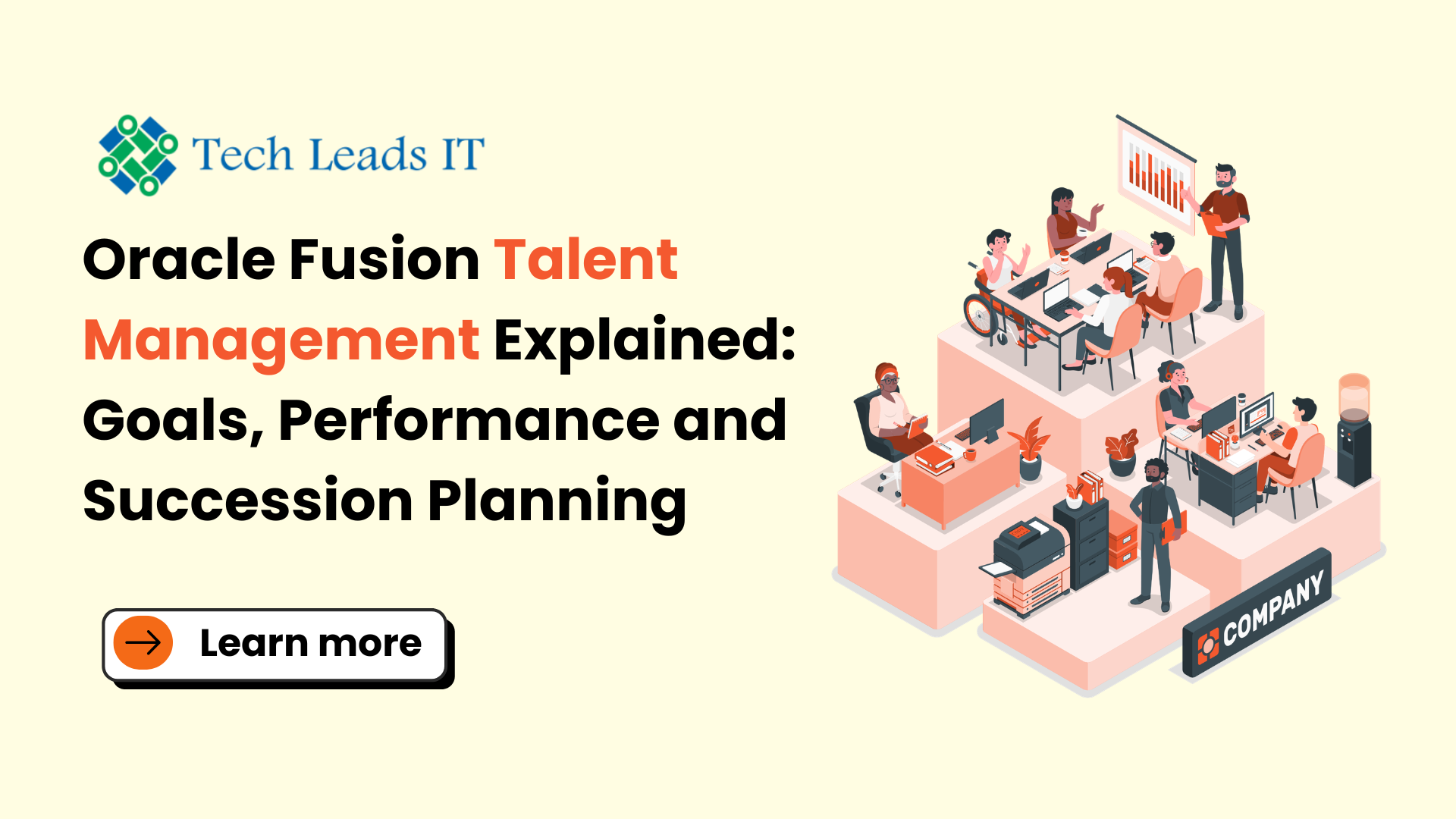
Oracle Fusion Talent Management Explained: Goals, Performance and Succession Planning

Author
Tech Leads IT
Our Happy Students
Follow us on


Here is a question at almost every Oracle HCM implementation kick-off meeting: "We have Core HR live. Why do we need Talent Management too?"
The answer takes about thirty seconds. Core HR tells you who works for your company their name, job, grade, manager, and employment history. Talent Management tells you whether that person is growing, performing, ready for promotion, and likely to stay. One module manages employment records. The other manages human potential. Both matter. And when they are configured together in Oracle Fusion Cloud HCM Release 24C, they create something most HR departments have never had: a single connected picture of every employee from hire to succession.
Global employee engagement fell from 23% to 21% in 2025, costing the world economy an estimated $438 billion in lost productivity (Gallup State of the Global Workplace, 2025). That number is not an HR problem. It is a business problem. And Oracle Fusion Talent Management is one of the tools organizations use to address it systematically rather than reactively.
An Oracle-certified HCM consultant with 15+ years of Oracle Fusion Cloud HCM implementations across manufacturing, pharmaceuticals, retail, and financial services at TechLeads IT breaks down how Oracle Fusion Talent Management actually works, the three core modules, how they connect, what they look like to configure, and where most implementations go wrong
What Is Oracle Fusion Talent Management and What Does It Include?
Oracle Fusion Talent Management is a set of modules inside Oracle Fusion Cloud HCM used to manage employee performance, goal-setting, career development, internal mobility, and succession planning on one connected platform.
Oracle Talent Management is designed to connect talent processes around a unified talent profile that brings together people, work, and skills data, helping employees understand how to grow, giving managers better context to coach their teams, and helping organizations make more evidence-based decisions.
The modules covered in this guide are the three most widely implemented in India and globally: Goal Management, Performance Management, and Talent Review and Succession Management. Each module runs independently. Each also integrates with the others in Oracle Fusion Cloud HCM Release 24C, meaning a goal set in Goal Management flows directly into the performance form an employee completes in Performance Management, and performance ratings from that form feed directly into Talent Review succession assessments.
Think of it like plumbing inside a building. Each pipe does a specific job. But they all connect to the same water supply. No single pipe matters as much as the system they form together.
Oracle was the highest-ranked vendor for Core HR and Talent Management for Global Organizations and Asia Pacific Market Use Cases in the Gartner Critical Capabilities for Cloud HCM Suites for 1,000+ Employee Enterprises report and was named a Leader in the Gartner Magic Quadrant for Cloud HCM Suites for the tenth consecutive year in September 2025. That recognition matters to implementations because it signals platform stability; clients investing in Oracle HCM Talent Management are building on a roadmap that has 10 years of consistent analyst validation behind it.
How Does Oracle Fusion Goal Management Work?
Oracle Fusion Goal Management is the module where employees and managers set, track, and align goals throughout the performance year, not just at annual appraisal time.
Oracle Fusion Goal Management enables organisations to create, align, and monitor goals across all levels of the enterprise. It helps achieve both performance and development objectives, ensuring that employees and managers have clearly defined objectives for success.
The following are the important parts of the Oracle Goal Management software, which include the Goal Library, Goal Plans, Goal Eligibility Profile, and AI-based goal recommendations. The following is what each component does.
The Goal Library is a centralized repository of pre-approved goals that HR and business leaders create at the organization level. Instead of every employee writing their own goal from scratch, which produces wildly inconsistent quality and alignment,t managers can assign goals from the library directly to their team. A manufacturing company with 3,000 employees might maintain a Goal Library with 200 goals organized by function: 40 goals for production supervisors, 35 for procurement leads, 30 for finance managers, and so on.
Goal Plans are the containers that define which goals apply to whom and during what time period. One may think of a Goal Plan titled "FY2026 Annual Performance Goals" comprising all active employees in India, spanning from April 2026 to March 2027, and involving the requirement of three to five goals for each employee. Without any Goal Plans, the concept of Goal Management remains an empty slate. The Goal Plans make the mass goal assignments feasible within a 5,000-person company.
Goal Eligibility Profiles define the employees eligible to be assigned different types of Goal Plans depending on such criteria as job family, legal entity, department, grade, or location. These are the points where implementation choices come into play. One of our clients used to ask a particular Team to include the contract workers in the annual performance goal cycle. As soon as we configured the eligibility profiles, it became impossible; the contractors were automatically excluded by the legal entity, thus saving the HR team from having to manage 400 erroneous goal assignments.
AI in Oracle Fusion Cloud HCM Release 24C helps in creating the goals by suggesting them according to the employee's position, skills, and organizational goals. Oracle's talent management ensures high-quality goal setting by the managers and employees and the provision of constructive feedback. The AI suggestions are recommendations that managers and employees decide whether to apply.
What does goal alignment look like across an organization? A VP of Operations sets a strategic goal: "Reduce per-unit manufacturing cost by 12% in FY2026." In Oracle Goal Management, that goal can be cascaded: production managers carry aligned goals around process efficiency, warehouse supervisors carry aligned goals around inventory accuracy, and procurement leads carry aligned goals around supplier cost negotiation. Each team member's goal contributes to the VP's strategic goal. In a well-configured Oracle Goal Management setup, every employee can see how their individual goal connects to the business outcome above it. That visibility is what separates Oracle's approach from a spreadsheet-based goal process.
Does your team currently know how their individual goals connect to the company's annual priorities? If the answer is no or "maybe," that is the problem Goal Management solves.
How Does Oracle Fusion Performance Management Work?
Oracle Fusion Performance Management is the module that handles employee performance evaluations from mid-year check-ins to annual appraisals using configurable performance document templates, rating scales, and feedback tools.
Oracle Fusion Performance Management is an option where organizations can effectively assess the performance of their employees based on certain goals that have been set either by themselves or the employees. This feature enables the organization to establish performance management processes that conform to their organizational culture and review processes.
The central object in Oracle Performance Management is the Performance Document, the form that defines what an employee is evaluated on, by whom, using what rating scale, and in what sequence. A Performance Document template includes sections for goal ratings, competency ratings, manager comments, employee self-assessment, and final overall rating. Each section is configurable: which competency model applies, whether self-assessment is mandatory, whether peers participate in the evaluation, and what rating scale is used (a 5-point scale, a 3-point scale, or a descriptive model).
Oracle Performance Management supports two fundamentally different approaches to performance review cycles. The traditional approach is the annual appraisal: one formal document per employee per year, completed between January and March, producing a rating that feeds into compensation planning. The modern approach, increasingly configured in Release 24C implementations, is continuous performance management: a combination of check-in conversations throughout the year, ongoing feedback, and a lighter formal review at year-end.
The difference in configuration between the two is significant. Annual appraisal configurations focus on weighting systems, what percentage of the final rating comes from goal achievement versus competency demonstration,n and calibration workflows that normalize ratings across managers before they are finalized. Continuous performance configurations focus on check-in templates, feedback frequency tracking, and anytime feedback tools that allow peers and managers to provide recognition or developmental input in real time.
Oracle HCM Performance Management was implemented in the pharmaceutical company with 4,500 people in Q1 2025 after conducting traditional yearly appraisals on paper for eleven years. Thanks to the shift to Oracle Fusion Cloud HCM Release 24C performance forms, the HR department could reduce from six to one week the time spent on collecting and processing appraisal information manually. The rating calibration solution, which guarantees normalization of the manager's rating before submitting it to ensure there will be neither inflation nor deflation of the grade, has found 340 discrepancies in the first cycle.
42% of employee turnover is preventable and usually due to problems such as bad management, lack of recognition, and lack of career development opportunities (Gallup). Oracle HCM Performance Management is the module where "recognition" and "clarity about career growth opportunities" become institutionalized instead of relying on the manager's ability to give feedback.
What is your current performance review completion rate? If it is below 85%, the problem is usually process has too many manual steps, too much email chasing, and no visibility into who has submitted and who has not. Oracle Performance Management solves this with workflow automation and manager dashboards showing real-time completion status across their team.
What Is Succession Planning in Oracle Fusion HCM and How Does It Work?
Oracle Fusion Succession Management is the module that identifies which employees are ready to step into critical roles now or within a defined development window and tracks the plans to prepare them.
Oracle Succession Management helps create succession plans to replace key personnel. Succession plans identify workers who are ready now, or can develop the necessary skills, for jobs and positions that aren't currently vacant, ensuring a smooth transition and helping organizations manage candidate development (Oracle Fusion Cloud Talent Management 24C Documentation).
Most organizations discover the need for succession planning the hard way. A senior finance director resigns with two weeks' notice. Nobody in the team has been prepared to cover the role. Recruitment takes four months. The business runs without a finance director for that entire period. Gallup estimates that replacing a leader can cost up to 200% of their salary. Succession planning does not prevent people from leaving. It prevents the organization from being caught unprepared when they do.
Oracle Succession Management in Release 24C works through four key setup elements: Succession Plans, Talent Pools, the Talent Review Meeting, and the 9-Box Performance-Potential Matrix.
A Succession Plan in Oracle HCM is created for a specific job, position, or person,n the "incumbent." The plan lists potential successors ranked by readiness: Ready Now, Ready in 1–2 Years, or Ready in 3–5 Years. Each successor in the plan can have a development plan attached with specific learning activities, stretch assignments, or mentoring relationships that move them from "Ready in 3 Years" to "Ready Now." Oracle's AI Suggested Successors feature in Release 24C analyzes the talent profile data of the organization's workforce and recommends candidates who match the competencies and experience requirements of the role being succession-planned. The AI suggestions are recommendations;s HR and managers decide whether these suggestions work or whether other options are more appropriate.
Talent Pools consist of teams of workers who are classified according to development potential rather than present job roles. Talent pools at Oracle HCM are defined according to skills or competencies of employees or their development potential. The Talent Pool titled "High Potential Leaders" could consist of 45 employees in India and Southeast Asia who are viewed as candidates for becoming directors in the future. Each individual from this talent pool has access to development opportunities.
The 9-Box Performance-Potential Matrix is the visual tool that powers Talent Review Meetings. The grid plots employees on two axes: Performance (current delivery, rated from Low to High) and Potential (readiness for growth, also rated Low to High). The nine cells of the grid describe different talent profiles: a "Star" in the top-right box has high performance and high potential; a "Solid Performer" in the center has strong performance but moderate growth potential. Succession candidates almost always come from the right column employees rated High Potential regardless of their current performance level.
Talent Review Meetings in Oracle HCM facilitate discussions about performance, provide actionable insights, and help craft individualized development plans, ensuring the right people are prepared for the right roles.
Here is how Talent Review Meetings work in practice. HR configures a Talent Review template — which boxes represent which talent profile, which rating model feeds the matrix, and which population is being reviewed. Managers then rate their direct reports on Performance and Potential in Oracle HCM before the meeting. The Talent Review Meeting itself shows all rated employees plotted on the 9-box grid. Leaders can move employees between boxes during the meeting, dragging a person from "Moderate Performance, High Potential" to a different cell if the group discussion reveals additional context. Notes, actions for development, and succession nominations are stored directly in Oracle and automatically create the follow-up actions.
A company that makes consumer goods with 5,000 people used Oracle HCM Release 24C in Q3 2025 to review 340 senior individual contributors in a single Talent Review Meeting. They nominated 28 people for 12 critical leadership positions. All 28 were enrolled in targeted development plans within Oracle Learn within 48 hours of the meeting. Previously, the same process using spreadsheets and email had taken three weeks to complete, and the development plan enrollment had to be tracked separately in a different system.
How Do Goals, Performance and Succession Connect in Oracle HCM?
The three modules Goal Management, Performance Management, and Succession Management are most powerful when configured to share data inside Oracle Fusion Cloud HCM Release 24C.
Here is the connection: An employee's goals, set in Oracle Goal Management, appear directly inside their Performance Document in Oracle Performance Management. The manager rates goal achievement as part of the performance evaluation. That performance rating combined with a separately assessed potential rating populates the 9-box grid in the Talent Review Meeting. Employees rated as high performers and high potential in the Talent Review become succession candidates in Oracle Succession Management. Their succession plans drive targeted learning and development activities in Oracle Learn.
The full cycle runs like this: Set goals → Evaluate performance against goals → Rate performance and potential in talent review → Identify succession candidates → Build development plans → Re-evaluate at next performance cycle. Each step feeds the next. None of the data needs to be re-entered manually. An HR director at a 3,000-person manufacturing company described it as "finally being able to see the whole movie, not just one frame at a time."
Oracle HCM Analytics helps organizations understand what impacts retention and proactively spot potential flight risks by analyzing performance, career growth, compensation, and engagement, identifying causes of turnover such as compensation, performance, geography, and tenure. That analytical layer sits on top of the talent data generated by Goal Management, Performance Management, and Succession Management working together. Without the underlying talent data, the analytics have nothing meaningful to analyze.
What Most Oracle HCM Talent Management Guides Get Wrong
Misconception 1: Talent Management is only for large enterprises.
Reality: Oracle Fusion HCM Release 24C supports talent management for organizations from 200 employees upward. Oracle Fusion HCM Now was launched specifically for Indian mid-market organizations, bundling core HR, talent management, and payroll in a configuration designed for companies that cannot dedicate a six-month implementation timeline. Wipro cut payroll-cycle time by 60% after migrating to Oracle HCM Now, and the platform processed 1.5 million payrolls monthly at mid-market scale. Mid-size companies avoiding Talent Management because they think it is enterprise-only are leaving their most important workforce intelligence tool unused. Why it matters: succession gaps and performance inconsistencies hit smaller organizations harder, not softer, because there is less redundancy in the talent pool.
Misconception 2: Switching on Oracle Talent Management automatically improves performance culture.
Reality: Oracle Talent Management is a platform, not a culture program. A company that runs poor performance conversations and avoids difficult feedback will run those same conversations inside Oracle but now in a structured digital form instead of on paper. The tools enforce process completion and provide data visibility. They do not replace the management quality that makes performance conversations actually useful. This is why implementations that include manager training on how to use performance conversations, not just how to click through Oracle forms, produce measurably better adoption outcomes. Why it matters: organizations that expect the software alone to fix their feedback culture will be disappointed. Organizations that pair Oracle with manager capability development will see real change.
Misconception 3: The 9-box grid is an objective assessment.
Reality: The 9-box performance-potential matrix in Oracle's Talent Review is only as good as the consistency of manager ratings going in. If two managers in different departments use the "High Potential" rating differently one applying it conservatively, the other generously the resulting grid compares employees on an uneven basis. This is why calibration configuration in Oracle Performance Management matters so much before Talent Review: without rating calibration, succession decisions made on 9-box data are built on inconsistent foundations. Why it matters: organizations that skip performance calibration setup treat 9-box outputs as fact when they are actually a starting point for discussion.
Quick Reference: Oracle Fusion Talent Management Module Comparison
| Module | Primary Purpose | Key Objects Configured | Who Uses It Daily |
| Goal Management | Set, align, and track employee goals | Goal Library, Goal Plans, Eligibility Profiles | Employees, Managers |
| Performance Management | Evaluate performance against goals and competencies | Performance Documents, Rating Scales, Calibration | Managers, HR, Employees |
| Talent Review and Succession | Identify high-potential talent and plan for critical role coverage | 9-Box Matrix, Succession Plans, Talent Pools | HR Leaders, Senior Managers |
| Talent Profiles | Central repository of employee skills and competency data | Content Sections, Model Profiles, Rating Models | HR, Managers |
If you are an HR professional, an Oracle HCM Functional Consultant, oran IT professional learning Oracle HCM skills, knowledge about how to integrate and relate these three modules is one of the most sought-after knowledge bases for Oracle HCM Consulting in 2026. TechLeads IT’s Oracle Fusion HCM Course offers Goal Management, Performance Management, and Succession Planning as an integration track and not as individual modules. Over 1,400 professionals have been trained through 14 batches, and 81% have been placed within 60 days of certification (TechLeads IT Alumni Survey, Q2 2026).
Frequently Asked Questions
Q: What is Oracle Fusion Talent Management and what modules does it include?
A: Oracle Fusion Talent Management is an application suite that falls under the Oracle Fusion Cloud HCM Application Suite and assists in managing the entire lifecycle of the talent of employees like goal setting, performance management, and succession planning, etc. The four modules of Oracle Fusion Talent Management include Goal Management, Performance Management, Talent Review & Succession Management, and Talent Profiles. In the 24C release, all four modules are based on the same talent profile; hence, the information about the achievement of goals is directly sent to Performance Management.
Q: How does Oracle Fusion Goal Management work in practice?
A: The Oracle Fusion Goal Management application helps companies to develop a common Goal Library, establish Goal Plans for certain groups of employees, and link personal goals with organizational objectives. Employees and their managers establish performance goals and developmental goals in the application. Goals automatically get populated in the employee's performance document during the review process. With Oracle Fusion Cloud HCM Release 24C, goals suggested by the AI are relevant to the employee's position and priorities of the organization.
Q: What is the 9-box grid in Oracle Fusion Talent Review and how is it used?
A: The 9-box performance-potential grid in Oracle Fusion Talent Review is a visual representation tool which uses two factors along its axes: Performance (employee’s current performance, from Low to High) and Potential (preparedness to develop, from Low to High), thus forming nine distinct employee profiles. HR managers and top management use the 9-box grid during Talent Review Meetings to recognize employees with high potential, to determine those at risk of retention, and also to nominate successors. Those who fall into the high performance/high potential quadrant (upper right) are considered the main succession nominees.
Q: How does Oracle Fusion Succession Planning help organizations reduce leadership gaps?
A: Oracle Fusion Succession Management allows organizations to develop succession plans for key roles or positions where possible successors are listed by their readiness levels, which could be Ready Now, Ready in 1-2 Years, or Ready in 3-5 Years. Each successor will have an individual development plan associated with them regarding the desired learning, mentoring, and stretch opportunities within Oracle HCM. Suggested Successors through AI in 24C suggests successors depending on the match of the talent profile. Hence, in case a key leader quits, the company already has a list of ready successors.
Q: Can Oracle Fusion Performance Management replace annual appraisals with continuous feedback?
A: Yes, Oracle Fusion Performance Management, version 24C, supports both annual and continuous performance management models. Under the continuous performance management model, check-in templates, any-time feedback features, and lightweight review documents are used all throughout the year instead of an annual appraisal process. Hybrid versions may also be configured where there is quarterly check-in through lightweight check-in documents, a mid-year formal review, and a year-end appraisal with goal and competency assessments.
Categories
Trending Blogs
Get Notified about Latest Blogs, Interview Questions & Job Alerts
Stay updated with the latest insights, trends, and expert tips on Oracle Fusion SCM. Subscribe to our newsletter and never miss an update!
Explore Our Related Blogs
0
LikesConnect with us


Subscribe




Top Categories
Popular Courses

© Copyright Tech Leads IT. All Rights Reserved
Stay Connected with us


