
Oracle Recruiting Cloud vs Oracle Fusion Core HR: How They Fit Together

Author
Tech Leads IT
Our Happy Students
Follow us on


A consultant fresh off a Core HR project once told me she assumed Oracle Recruiting Cloud was just another HCM tab. It isn't. That mix-up costs new consultants real time on their first ORC project. Oracle Recruiting Cloud vs. Core HR is one of those comparisons that looks simple until you're the one configuring the handoff between them. ORC manages the candidate before they're hired. Core HR manages the worker after they are. This guide walks through where one ends and the other begins. It covers exactly how candidate data crosses that line, and whether a consultant should learn both at the same time or in sequence. This guide directly answers whether ORC is part of Core HR, how candidate data actually moves between the two, and whether learning them together makes sense for your career path.
At a glance: Oracle Recruiting Cloud vs Core HR
| Oracle Recruiting Cloud (ORC) | Oracle Fusion Core HR | |
| Manages | Candidates, before hire | Workers, after hire |
| Oracle pillar | Talent Management | Core HR |
| Key data | Applications, interviews, offers | Work relationships, assignments |
| Trigger to switch | Job offer acceptance | N/A, this is the starting point |
Is Oracle Recruiting Cloud Part of Core HR?
No. Oracle Recruiting Cloud is a separate product inside the Talent Management pillar of Oracle Fusion Cloud HCM. It isn't a module within Core HR itself. The two sit side by side in the same HCM suite, not one inside the other. They share the same underlying platform and some common data, but they serve different stages of the employee lifecycle.
Think of them like a hotel's front desk and its housekeeping system. The front desk, which is ORC, handles every guest before they have a room: inquiries, bookings, check-in logistics. Housekeeping, which is Core HR, takes over once someone actually has a room assigned and needs ongoing service. A guest doesn't exist in the housekeeping system until check-in happens. A candidate doesn't exist as a worker record in Core HR until a very specific event triggers that creation.
That event is job offer acceptance. Oracle's own documentation on using Recruiting describes this handoff directly. When the candidate accepts the job offer, the application is handed over to the HR specialist who finalizes the HR records for that worker (Oracle Fusion Cloud Talent Management, docs.oracle.com). Before that moment, everything about the person lives in ORC as candidate data. Phase tracking, interview feedback, offer details- none of it touches a Core HR worker record yet. After that moment, an HR specialist takes the handoff. They build the actual employee or contingent worker record inside Core HR. The two systems are genuinely separate. They're connected by exactly one bridge: the accepted offer.
This separation isn't an accident of design. It mirrors how most organizations actually think about headcount. A candidate isn't on payroll. They aren't eligible for benefits. They don't show up in a headcount report. None of that changes until the offer is accepted and HR finalizes the record. Keeping candidate data and worker data in genuinely separate systems, even within one connected platform, protects that distinction instead of blurring it.
How Does Candidate Data Move From ORC to Core HR?
Candidate data moves from ORC to Core HR through a defined sequence. The application progresses through recruiting phases. A job offer gets created and approved. The candidate accepts it. An HR specialist finalizes the new worker record in Core HR. Each step has a specific action behind it inside the application, not a background sync job running quietly.
How does this actually look on screen? Here's the real sequence, grounded in Oracle's own Recruiting documentation and implementation guidance.
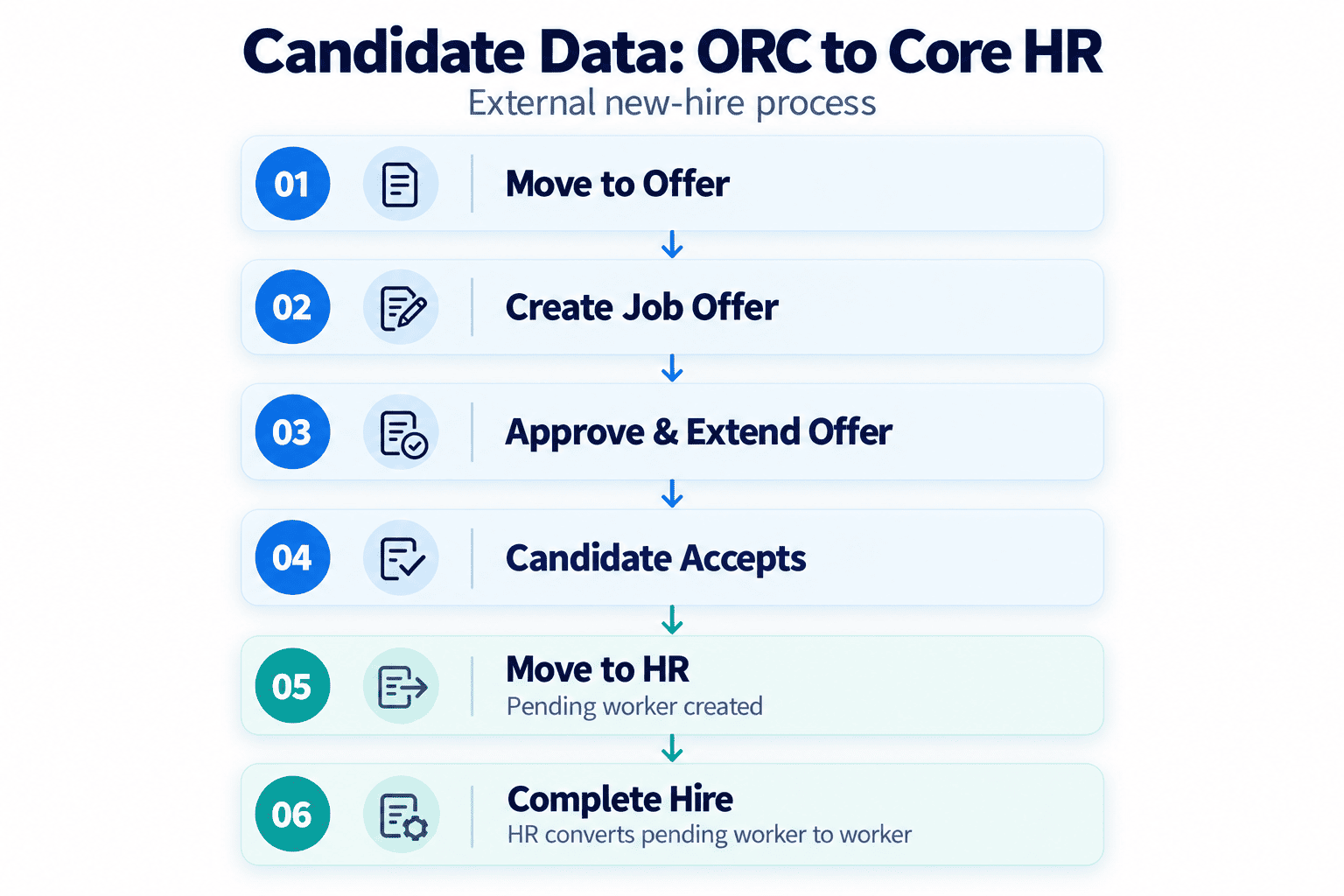
Step 1: Move the application to the Offer phase.
A recruiter changes the application's phase field to Offer once a candidate clears interviews. This step doesn't move any HR data yet. It just changes where the application sits in the recruiting pipeline.
Step 2: Create the job offer.
The recruiter or hiring manager builds out the offer record directly from the application. This includes start date, legal employer, assignment details, and compensation information. This is the first point where real HR-relevant data starts getting captured, even though it still lives inside the recruiting side of the system.
Step 3: Route the offer for approval and extend it.
The offer moves through an approval chain defined by the organization's business rules. Once approved, the recruiter extends the offer to the candidate.
Step 4: Candidate accepts the offer.
This is the trigger point. Acceptance is the single event that hands the record from recruiting to HR, exactly as Oracle's documentation describes (Oracle Fusion Cloud Talent Management, docs.oracle.com). This step carries real weight on a project timeline too. SHRM's 2025 Recruiting Executives Benchmarking report found that median time-to-fill, measured from job requisition to offer acceptance, now runs roughly 45 days for both executive and nonexecutive roles (SHRM, 2025). Every one of those 45 days happens entirely inside ORC. None of it touches Core HR until this exact step is completed.
Step 5: HR specialist finalizes the worker record.
The HR specialist completes the new hire transaction inside Core HR. They create the employee or contingent worker assignment using the data carried over from the offer. From this point forward, the person exists in Core HR with a work relationship, an assignment, and eligibility for the downstream processes, like payroll, that depend on that record existing.
One honest wrinkle worth knowing before your first ORC project: converting an existing contingent worker into an employee follows a slightly different path than hiring someone brand new. Oracle's documentation on this scenario specifies using an "Add Employee Work Relationship" action on the job offer. It also requires terminating the prior contingent work relationship before the new employee relationship starts (Oracle Fusion Cloud, docs.oracle.com). That's a detail a lot of training material skips entirely. It's exactly the kind of gap that trips up a consultant mid-project, usually discovered the hard way when a contingent worker's records don't convert cleanly.
Should You Learn ORC and Core HR Together?
Yes. Learning Core HR fundamentals before or alongside ORC makes more sense than learning ORC in isolation. Every ORC project eventually depends on understanding what happens to the data once it lands in Core HR. ORC without Core HR context is like learning to take restaurant orders without knowing anything about what happens in the kitchen.
What's your current comfort level with Core HR work relationships and assignments? That answer should shape your learning order. A consultant who already understands person records, work relationships, and assignment structures in Core HR picks up ORC configuration faster. The destination data model is already familiar. Someone starting from zero on both ends up learning two unfamiliar systems at once, which slows everyone down.
That said, ORC has its own substantial scope. Candidate experience configuration, career sites, interview scheduling, and offer letter templates are all ORC-specific skills with no real Core HR equivalent. A consultant aiming for recruiting-focused project work still needs deep ORC expertise beyond what Core HR knowledge alone provides. The practical order that works best for most career switchers: build solid Core HR fundamentals first, then layer ORC on top once work relationships and assignments feel familiar. What is Oracle Fusion HCM covers exactly that Core HR foundation, including the modules and career scope that ORC eventually connects into.
What Do SHRM and Josh Bersin Say About Connected HR Systems?
Disconnected HR technology is a named, recognized problem, not just an Oracle-specific implementation headache. Josh Bersin, CEO of the Josh Bersin Company, calls this "the kitchen drawer problem." He describes it this way: "every tool was purchased for a great reason, and next thing you know you have a drawer full of stuff" (SHRM, quoting Josh Bersin). That's precisely the failure mode ORC-to-Core HR integration is designed to avoid. Both systems live inside one connected platform rather than requiring a separate sync tool between two unrelated vendors.
Bersin's broader point about where HR technology is heading reinforces why this connection matters now more than ever. "HCM technology is now used for recruiting, onboarding, training and all aspects of employee experience," he said (SHRM, quoting Josh Bersin). Recruiting and Core HR aren't treated as separate concerns anymore in modern platforms. They're treated as one continuous employee lifecycle with different stages. A consultant who only understands one half of that lifecycle is working with half the picture, no matter how skilled they are in their own module.
This is exactly why the skill gap between isolated module knowledge and true hire-to-retire fluency matters for career growth. Recruiters and HR teams increasingly expect a consultant to speak both languages, candidate experience and worker administration, rather than handing off confusion at the exact point where the two systems meet. Our guide on [INTERNAL LINK: Oracle Fusion Payroll configuration mistakes] covers what happens on the other end of this same lifecycle, once a new hire moves from Core HR into active payroll processing.
What Most Training Material Gets Wrong About ORC and Core HR
Misconception: Oracle Recruiting Cloud and Core HR share one combined configuration.
Reality: They're separate products within the same HCM suite, configured independently, connected through the job offer acceptance event rather than shared setup screens.
Misconception: Candidate data automatically becomes employee data the moment an offer is created.
Reality: The offer record exists entirely within ORC until the candidate accepts it. Only acceptance triggers the handoff where an HR specialist builds the actual Core HR worker record.
Misconception: Converting a contingent worker to an employee works exactly like hiring a brand-new candidate.
Reality: Contingent-to-employee conversion needs a specific "Add Employee Work Relationship" action and proper termination of the prior work relationship. That differs from a standard new hire flow.
Quick Reference: Where ORC Ends and Core HR Begins
| Stage | System | What Happens |
| Application and interviews | ORC | Candidate data only, no HR record exists |
| Offer creation and approval | ORC | Offer details captured, still no Core HR record |
| Offer acceptance | Handoff point | Record passes from recruiting to HR specialist |
| New hire finalization | Core HR | Employee or contingent worker record created |
| Ongoing employment | Core HR | Work relationships, assignments, payroll eligibility |
Frequently Asked Questions
Q: Is Oracle Recruiting Cloud part of Core HR?
A: Not inside. It is a different product within Talent Management, part of Oracle Fusion Cloud HCM. It sits alongside Core HR in the menu, but is linked via the job offer acceptance event.
Q: How does candidate data move from ORC to Core HR?
First, the application gets processed in the recruiting stages. You receive a job offer (made and approved), and you accept it. So what's next? An HR prof. completes your worker record in Core HR based on the offer.
Q: Should I learn ORC and Core HR together?
A: Build Core HR fundamentals first, since understanding work relationships and assignments makes ORC configuration easier to learn. Then layer ORC-specific skills like career sites and offer templates on top.
Q: What happens when a candidate accepts a job offer in Oracle Fusion?
A: Acceptance The candidate hands off from recruiting to HR. The candidate's job application is handed off to an HR specialist, who completes the real employee or contingent worker record in Core HR.
Q: Is Oracle Recruiting Cloud the same as an ATS?
A: ORC functions as Oracle's applicant tracking system. It's built as an integrated part of Oracle Fusion Cloud HCM rather than a standalone product. That's what allows the direct handoff into Core HR without a separate integration tool.
Q: What's the difference between a candidate record and a worker record in Oracle Fusion?
A: A candidate record lives entirely in ORC and holds application, interview, and offer data with no payroll or benefits eligibility attached. A worker record lives in Core HR and includes a work relationship and assignment, created only after the HR specialist finalizes the new hire following offer acceptance.
Build Hire-to-Retire Fluency, Not Just One Module
Understanding where ORC ends and Core HR begins is the foundation. Actually configuring that handoff on a live project takes hands-on practice with both sides of the process. One honest limitation worth naming: no amount of reading replaces watching a real offer acceptance trigger a real new hire transaction, since every client configures approval chains and offer templates a little differently. Structured, hands-on training closes that gap faster than documentation alone.
Our Oracle Fusion HCM training program covers Core HR fundamentals alongside Oracle Recruiting Cloud, so you learn the full candidate-to-employee flow rather than one isolated piece of it.
Explore our Oracle Recruiting Cloud training track and build the kind of hire-to-retire fluency that makes you useful across an entire Oracle Fusion HCM project, not just one module of it.
Categories
Trending Blogs
Get Notified about Latest Blogs, Interview Questions & Job Alerts
Stay updated with the latest insights, trends, and expert tips on Oracle Fusion SCM. Subscribe to our newsletter and never miss an update!
Explore Our Related Blogs
0
LikesConnect with us


Subscribe







© Copyright Tech Leads IT. All Rights Reserved
Stay Connected with us


