
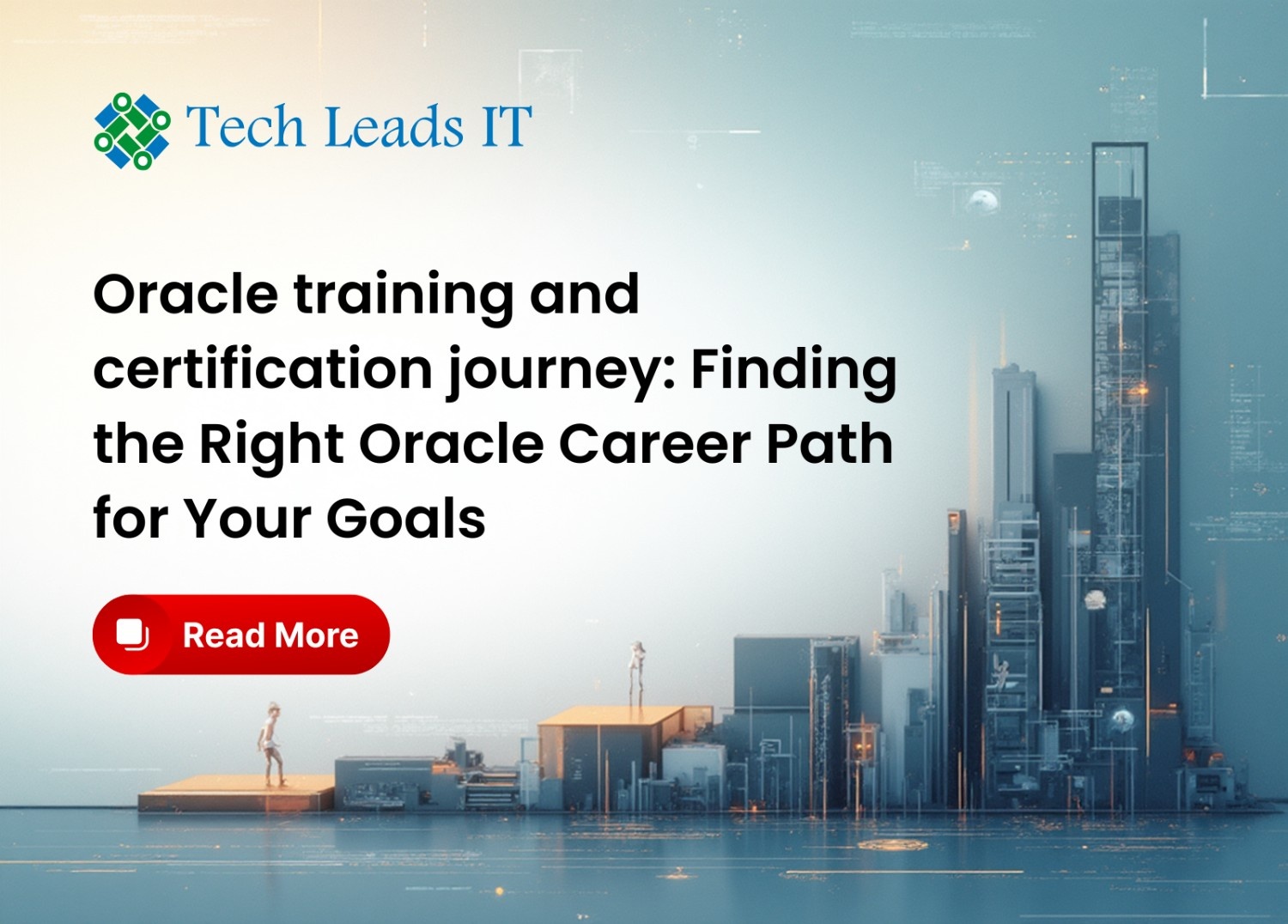
Oracle training and certification journey: Finding the Right Oracle Career Path for Your Goals

Author
Tech Leads IT
Our Happy Students
Follow us on


If you speak to professionals who have spent a few years in enterprise environments, one thing becomes clear very quickly—career growth is rarely accidental. It usually comes from choosing skills that businesses genuinely rely on. This is exactly where Oracle training and certification journey fits in. Over the years, Oracle has quietly remained at the centre of how large organizations run finance, HR, supply chains, and operations.
With cloud adoption accelerating across industries, Oracle cloud learning path is no longer an optional upgrade. It has become a practical requirement for professionals who want their skills to stay relevant over the long term. This article is written as a realistic career guide—grounded, experience-oriented, and focused on helping you choose the right Oracle path without marketing noise.
Why Oracle training and certification journey Matter Today
In real-world business environments, Oracle systems are not used for experimentation—they run mission-critical processes. Payroll, supplier payments, inventory planning, compliance reporting—these are not areas where companies can afford errors. That’s why organizations continue to invest in Oracle platforms and, more importantly, in people who understand them.
What makes Oracle training and certification journey different from many short-term tech courses is its strong connection to business workflows. You are not just learning screens or transactions. You are learning how departments interact, how approvals work, and how data moves across the organization.
From what many hiring managers point out, Oracle-trained professionals are often preferred because they understand both sides—technology and business. Certification simply formalizes this trust and signals that you can work in real enterprise environments, not just in theory.
Popular Oracle Certification Paths and Career Roles
One of the most common mistakes professionals make is choosing an Oracle course based on popularity rather than relevance. Oracle offers multiple paths, and each one serves a specific type of career profile.
Oracle Cloud ERP and Financials
This path works especially well for finance and accounting professionals. It covers General Ledger, Accounts Payable, Accounts Receivable, Assets, and Cash Management. People who complete this path often move into roles such as Oracle Functional Consultant, ERP Analyst, or Finance Systems Specialist.
What makes this path attractive is its long-term stability. Finance systems are not replaced frequently, and professionals with Oracle Financials expertise often find consistent demand across industries.
Oracle Fusion HCM
Oracle Fusion HCM is well suited for HR professionals who want to move closer to technology-driven roles. Modules such as Core HR, Payroll, Absence, and Talent Management help HR teams manage large workforces efficiently.
Professionals who take this route usually transition into HRIS Analyst or HCM Consultant roles. This path is particularly valuable for those who already understand HR policies and want to add a strong systems skill to their profile.
Oracle Fusion SCM
For supply chain, procurement, and operations professionals, Oracle Fusion SCM can be a game changer. It covers Inventory, Procurement, Order Management, Costing, and Planning.
In practice, SCM systems are complex and deeply integrated with business decisions. Because of this, experienced Oracle SCM professionals often become key stakeholders in implementation and optimization projects.
Oracle Cloud Infrastructure (OCI)
OCI is a more technical path, typically chosen by IT professionals. It focuses on cloud infrastructure, networking, security, and identity management. This track is best suited for those aiming for cloud administration or infrastructure engineering roles.
Each of these certification paths aligns closely with real job responsibilities, which is why Oracle skills remain relevant even as technology trends shift.
How to Select the Right Oracle Training for Your Profile
Choosing the right Oracle Training path starts with an honest assessment of your background. Instead of trying to learn everything, focus on what complements your existing experience.
- If you come from finance or accounting, Oracle Cloud Financials is usually the most natural fit
- If you work in HR, Oracle Fusion HCM aligns closely with your day-to-day responsibilities
- If your experience is in supply chain or procurement, Oracle Fusion SCM offers strong career leverage
- If you are from an IT background, Oracle Cloud Infrastructure may be the right direction
Professionals who succeed with Oracle typically specialize first and expand later. Depth matters more than breadth in enterprise systems.
Oracle Certification Training: Online vs Classroom Learning
Many learners spend a lot of time debating training formats. In reality, the format matters far less than the quality of learning.
Oracle Certification Online Training works well for working professionals because it offers flexibility and access to recorded sessions. Classroom training can provide structure and peer interaction. However, both formats fail if they lack real-world context.
Effective Oracle cloud learning path should always include:
- Access to live or simulated Oracle environments
- Business scenario-based explanations
- Hands-on configuration exercises
- Guidance for certification and interviews
Without these elements, even the best-designed course remains incomplete.
What Career Progression and Earnings Look Like After Oracle training and certification journey
Career growth in Oracle roles is rarely overnight, but it is steady. Most professionals start in support or junior consultant roles and gradually move into implementation, optimization, or leadership positions.
Salary progression depends on factors such as specialization, project exposure, and cloud implementation experience. In many cases, professionals with Oracle Fusion SCM or Financials experience see faster growth because these modules directly impact business outcomes.
Another advantage of Oracle skills is transferability. The same knowledge can be applied across manufacturing, retail, banking, healthcare, and logistics.
Cloud adoption is not a temporary phase. Organizations are restructuring their systems around cloud-first strategies, and Oracle plays a major role in this shift. Oracle cloud learning path helps professionals stay aligned with this direction.
More importantly, Oracle skills are not limited to tools. They develop an understanding of enterprise controls, compliance, and scalable system design. These are skills that remain valuable even as interfaces and features evolve.
Final Thoughts
Oracle training and certification journey is not about chasing trends. It is about building a career that grows steadily alongside enterprise technology. Whether you are transitioning from a non-IT background or strengthening your existing role, Oracle cloud learning provides a structured and reliable path forward.
Choosing the right module, learning it deeply, and applying it in real scenarios is what ultimately defines success in the Oracle ecosystem.
Frequently Asked Questions
1. Is Oracle training still worth it in 2025 and beyond?Yes. Oracle skills continue to be relevant because many large enterprises rely on Oracle Cloud applications for finance, supply chain, HR, and databases. As companies modernize legacy systems, professionals with Oracle training and certification journey and Oracle cloud learning path remain in steady demand.
2. Which Oracle certification is best for beginners with no IT background?Beginners often start with functional roles such as Oracle Fusion Financials, HCM, or SCM. These paths focus more on business processes than deep coding and are commonly included in structured Oracle Certification Training programs.
3. Can non-technical professionals build a career through Oracle training?Yes. Many Oracle roles value domain expertise in finance, HR, supply chain, or operations. With the right Oracle Training, non-technical professionals can move into consultant or analyst roles without deep programming knowledge.
4. How long does it take to become job-ready after Oracle cloud training?Most learners become job-ready within 3–6 months, depending on prior experience and hands-on exposure. Practical labs and real-time projects included in Oracle cloud learning path significantly accelerate readiness.
5. Do employers value Oracle certification or real-time project experience more?Both matter. Certifications validate structured knowledge, while project experience proves application. Strong Oracle training and certification journey programs intentionally combine both.
6. Which Oracle certification has the best career scope?
Oracle certifications linked to core business functions—such as Financials, HCM, and SCM—currently offer the strongest career scope. Among them, Oracle Fusion SCM and Oracle Cloud Financials are often valued for their direct impact on business operations.
7. Can I get a job after completing the Oracle training and certification journey?
Yes, many professionals do. Job outcomes improve significantly when Oracle training and certification journey is combined with hands-on practice, business use cases, and interview preparation. Certification alone helps, but practical exposure makes the real difference.
Categories
Trending Blogs
Get Notified about Latest Blogs, Interview Questions & Job Alerts
Stay updated with the latest insights, trends, and expert tips on Oracle Fusion SCM. Subscribe to our newsletter and never miss an update!
Explore Our Related Blogs
0
LikesConnect with us


Subscribe




Top Categories
Popular Courses


© Copyright Tech Leads IT. All Rights Reserved
Stay Connected with us


