
Career Transition to IT After 30: What Works in 2026

Author
Tech Leads IT
Our Happy Students
Follow us on


You are 32, eight years into an operations job, and a younger colleague just moved into IT on better pay. Has that door closed for you? No. A career transition to IT after 30 works when you stop competing with fresh graduates on coding and start selling the business knowledge you already own. TechLeads IT trains working professionals in Oracle Fusion Cloud applications, and more than 5,000 learners have taken its Oracle Cloud SCM training. In this guide, you'll learn which IT paths suit switchers, how long the move takes, and the five steps that carry it.
"Is 30 too late to switch to an IT career?", "What IT paths suit career switchers best?" and "How long does a career transition to IT typically take?"
Is 30 too late to switch to an IT career?
No. Thirty is not too late to switch to an IT career, because employers now hire for capability more than age. India's technology sector employs close to 6 million people and added about 135,000 jobs in FY26 (NASSCOM Strategic Review, 2026). A 32-year-old with eight years in procurement brings process knowledge that no fresher has.
Why does age matter less than people fear? The NASSCOM Strategic Review 2026 says talent strategies in Indian tech have moved from "headcount-first to capability-first". Companies hire fewer people now, and they want each one to understand the business problem behind the screen. That shift favours someone who has lived the problem.
72% of Indian professionals said they were looking for a new role in 2026 (LinkedIn, 2026). In the same research, 74% of recruiters in India said qualified candidates had become harder to find (LinkedIn research reported by PTI, 2026). Plenty of applicants. Too few who fit. Recruiters are short of matching skills, not young people.
Think of a hospital hiring for its billing software team. A 23-year-old coder still has to learn what a claim denial is. A 34-year-old who ran the billing desk for nine years already knows where claims get stuck.
One caution for anyone planning to switch to an IT career late: hiring is slower than it was. Sector headcount grew only 2.3% in FY26 (NASSCOM Strategic Review, 2026), and campus-style fresher drives often filter by graduation year. The door that opens for a late switcher is lateral hiring, where a team needs someone who knows procurement, payroll or finance and can learn the tool.
What IT paths suit career switchers best?
The IT paths that suit career switchers best are the ones where business knowledge counts more than code: ERP (Enterprise Resource Planning) functional consulting, business analysis, software testing and IT support. You configure, test or explain software instead of writing it. A former warehouse supervisor, for example, maps directly to an inventory role in Oracle Fusion Cloud SCM (Supply Chain Management).
| IT path | Coding needed | Background that transfers best | Main hurdle for switchers |
| ERP functional consultant (Oracle Fusion, SAP) | None to light | Procurement, supply chain, finance, HR | Needs practice on a live system |
| Business analyst | None | Process-heavy or client-facing roles | Few true entry-level openings |
| Software tester (QA) | Light; more for automation | Quality, audit, detail-driven work | Automation skills expected early |
| IT support / help desk | None | Customer service, troubleshooting | Lower starting pay, shift work |
| Software developer | Heavy | Maths or engineering base | Longest learning curve |
So which is the best IT path for career switchers? Pick the row where your old job appears in the third column.
Most career-change guides skip ERP functional consulting. An ERP system runs a company's purchasing, inventory, orders, payroll and accounts in one place. A functional consultant is its architect, not its bricklayer: the consultant decides how the rooms connect and the platform lays the bricks. In Oracle Fusion Cloud SCM Release 26C, the consultant defines inventory organizations, approval rules and purchase order types through setup screens, not program code. Oracle's free 26C readiness documentation shows how each feature is set up.
Picture a 34-year-old purchase executive at a 600-person auto-parts manufacturer. For nine years she has raised purchase orders and chased supplier approvals. In Oracle Fusion Cloud Procurement, those same steps exist as configurable flows. She already knows what a requisition is. She only needs to learn where Oracle keeps it.
When LinkedIn published Jobs on the Rise 2026, its career expert Nirajita Banerjee made a similar point: professionals who pair AI literacy with domain expertise are better placed as hiring spreads beyond pure technology roles (LinkedIn, reported by Telangana Today, 2026).
ERP work has a real limitation. Oracle updates Fusion every quarter, and 473 of the 811 features in Release 26C carry the flag for Redwood, Oracle's newer interface (Flexagon, 2026). Screens you learn this year will look different next year. So learn the business process first and the clicks second, because the process outlives the screen.
How long does a career transition to IT typically take?
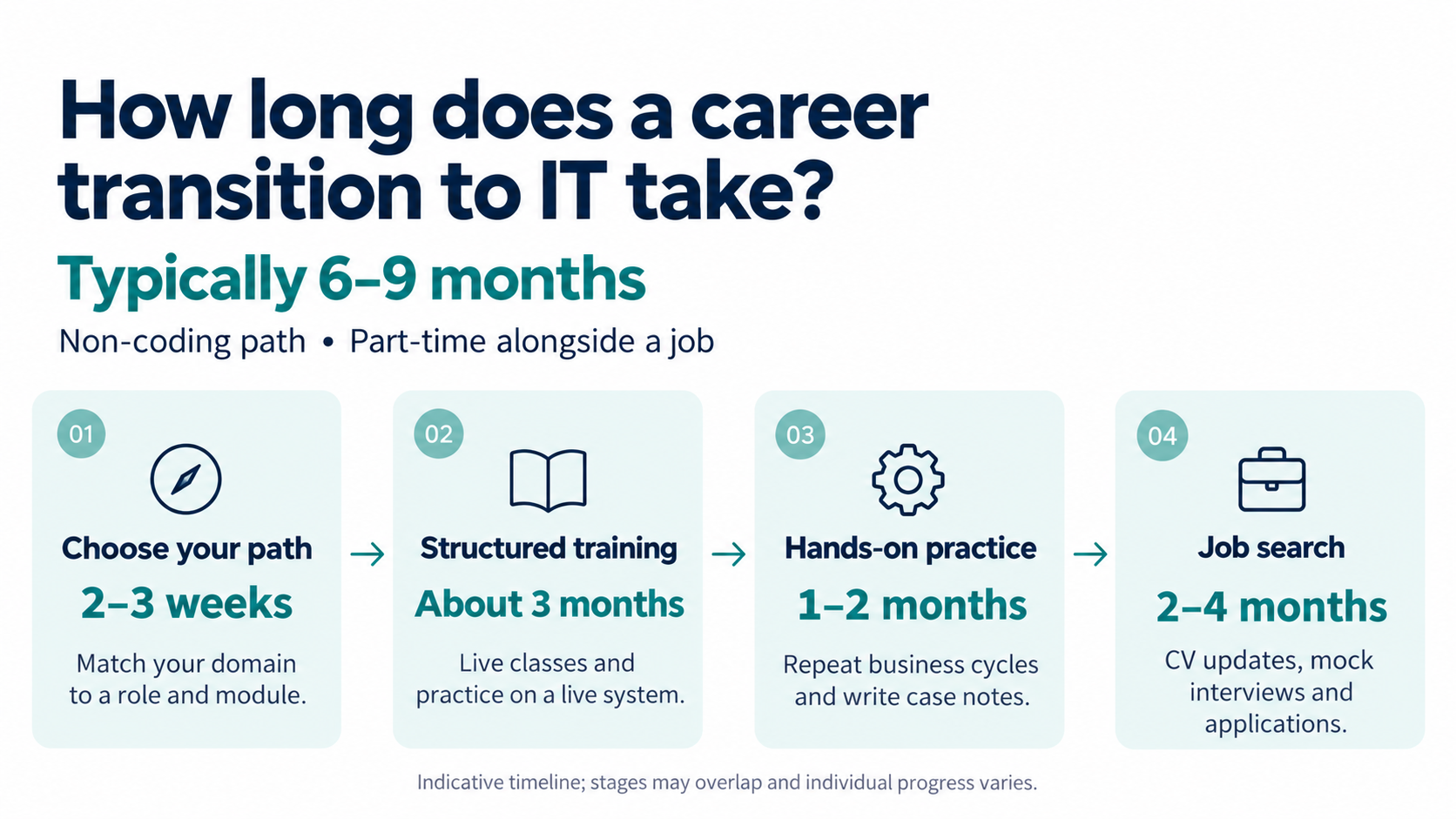
A career transition to IT typically takes about six to nine months on a non-coding path, studied part-time alongside a job. That splits into about three months of structured training, one to two months of hands-on practice, and two to four months of job search. A buyer moving into Oracle Fusion Cloud Procurement usually lands at the shorter end.
| Stage | What you do | Typical duration |
| Choose the path | Match your domain to a role and module | 2–3 weeks |
| Structured training | Live classes plus practice on a live system | About 3 months |
| Hands-on consolidation | Repeat full business cycles, write case notes | 1–2 months |
| Job search | Rewrite CV, mock interviews, applications | 2–4 months |
How do you know which end of the range you will land on? Three things decide it: weekly study hours, how close your old domain sits to the new role, and how early you start interview practice.
The Oracle Fusion SCM course at TechLeads IT runs for three months. Its published guidance says freshers typically become job-ready within two to three months of regular practice, and people with prior SCM or ERP exposure in one to two.
Budget most slack for the job search. Applications per job opening in India have more than doubled since early 2022. Put your effort into referrals and into openings where the job description names your domain.
Treat the switch like training for a first half-marathon. You add distance each week, and you book the race date early so the training has a deadline. How many hours can you protect every week?
Pay needs the same realism. Published starting pay for Oracle Fusion SCM freshers is 3–6 LPA. If you earn more today, your first IT role may be a sideways step, so keep savings ready.
If this timeline looks like one you could keep, the Oracle Fusion SCM online training at TechLeads IT is built for this situation. It starts with basic concepts and requires no prior SCM or ERP experience.
How do you make a career transition to IT after 30, step by step?
To make a career transition to IT after 30, follow five steps in order: audit your domain knowledge, choose a path that reuses it, train on a live system, build proof of work, and apply for lateral roles. Choosing a course before choosing a path is the mistake that costs switchers the most time.
Your experience is the passport and tool training is the visa. You need both at the border.
Step 1: Audit what you already know
List every business process you have run: purchase orders, payroll runs, month-end close, stock counts.
Step 2: Choose a path that reuses it
Match the list to a role. Procurement maps to Oracle Fusion Cloud Procurement, HR maps to Oracle Fusion Cloud HCM (Human Capital Management), and accounts maps to Oracle Fusion Cloud Financials. The TechLeads IT course catalogue shows how the modules divide. Unsure between platforms? Read Oracle Fusion SCM vs SAP SCM career comparison.
Step 3: Train on a live system
Videos are not enough. Get login access to a practice environment and repeat a full cycle such as procure-to-pay until you can run it without notes.
Step 4: Build proof of work
Write up three or four scenarios you configured: the business problem, the setup you chose, the result. Post them on LinkedIn.
Step 5: Apply for lateral roles
Target support and junior functional roles where the job description names your domain. The TechLeads IT careers page is one place to start looking.
Where switchers go wrong
The most common mistake is hiding the old career. A store manager who wants to forget retail and start fresh is throwing away ten years of stock counts and supplier disputes, which is exactly why a project team would want that person. Configure the process you ran in your last job first. It sticks faster.
What most career transition to IT after 30 guides get wrong
Most guides repeat three claims that current data does not support.
Misconception: You must learn to code to work in IT.
Reality: Functional consultants, business analysts and testers configure, document and check software. The Oracle Fusion SCM curriculum at TechLeads IT opens with Functional Setup Manager, a configuration tool, not a programming language (TechLeads IT course page, 2026).
Why it matters: You can skip a year of coding study that the role never asks for.
Misconception: Retraining at 30 shows you have fallen behind.
Reality: Employers expect 39% of workers' core skills to change by 2030, and 59 of every 100 workers will need training by then (World Economic Forum Future of Jobs Report, 2025).
Why it matters: Mid-career retraining is now normal, so a recent course on your CV reads as initiative.
Misconception: The fastest-growing job title is the best one to target.
Reality: AI Engineer is the fastest-growing role in Hyderabad, Bengaluru and Pune (LinkedIn Jobs on the Rise, 2026), but it demands deep programming and maths.
Why it matters: A switcher gets hired sooner in a role where past experience counts from the first day.
Frequently asked questions
Q: Is 30 too late to switch to an IT career in India?
A: No. India's technology sector employs close to 6 million people and added about 135,000 jobs in FY26 (NASSCOM Strategic Review, 2026). A professional over 30 with experience in procurement, finance or HR can enter through lateral roles such as ERP functional consultant, business analyst or software tester.
Q: What is the best IT career path for someone without a coding background?
A: ERP functional consulting, business analysis, software testing and IT support are the best IT paths for people without a coding background. ERP functional consulting fits professionals from procurement, supply chain, finance or HR especially well, because Oracle Fusion Cloud Applications are configured through setup screens that mirror processes they already run.
Q: How long does it take to move into IT from a non-IT job?
A: Plan for six to nine months on a non-coding path while working full-time: about three months of structured training, one to two months of hands-on practice, and two to four months of job search. People whose previous domain matches the new role, such as a buyer moving into Oracle Fusion Cloud Procurement, usually finish at the shorter end.
Q: Will I have to take a pay cut when I switch to IT after 30?
A: Possibly, at first. Published starting pay for Oracle Fusion SCM freshers in India is 3–6 LPA (TechLeads IT course page, 2026). If your current salary is higher, the first IT role can be a sideways or downward step. Keep savings in reserve and judge the switch on a three-year view, not the first offer.
Q: Is Oracle Fusion a good choice for non-IT professionals changing careers?
A: Oracle Fusion suits non-IT professionals from supply chain, procurement, finance or HR, because functional roles configure the system instead of coding it. Oracle ships updates every quarter, and 473 of the 811 features in Release 26C carry the flag for the newer Redwood interface (Flexagon, 2026). Learn the business process first, because the screens keep changing.
Your next step
A career transition to IT after 30 comes down to one decision: build on what you already know instead of starting from zero. More than 5,000 learners have trained in Oracle Cloud SCM at Tech Leads IT. Explore functional consulting training designed for career switchers, and sit in on a free live demo before you commit.
Categories
Trending Blogs
Get Notified about Latest Blogs, Interview Questions & Job Alerts
Stay updated with the latest insights, trends, and expert tips on Oracle Fusion SCM. Subscribe to our newsletter and never miss an update!
Explore Our Related Blogs
0
LikesConnect with us


Subscribe






© Copyright Tech Leads IT. All Rights Reserved
Stay Connected with us


