
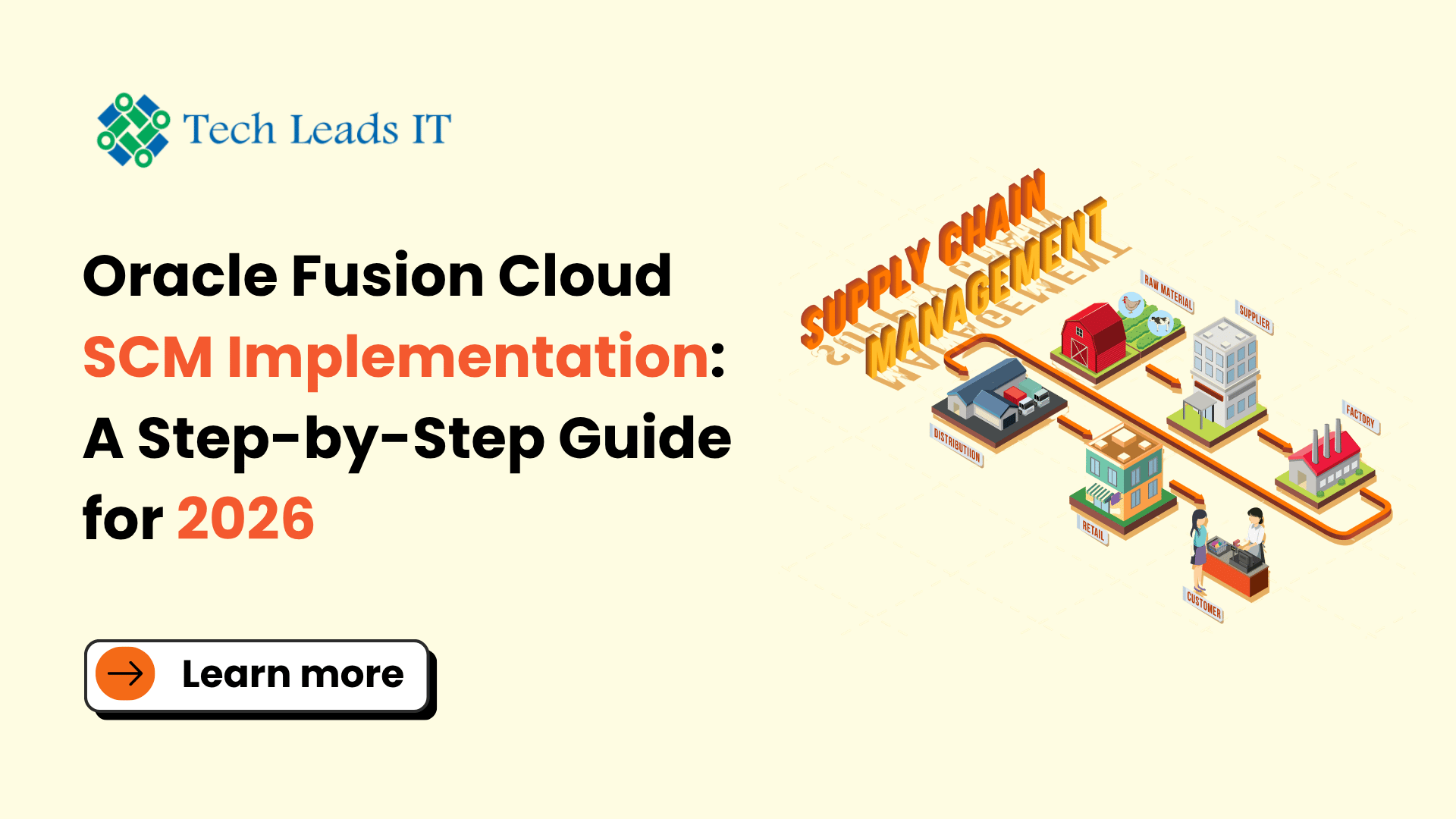
Oracle Fusion Cloud SCM Implementation: A Step-by-Step Guide for 2026

Author
Tech Leads IT
Our Happy Students
Follow us on


Most Oracle Fusion Cloud SCM implementation projects don't fail because the software is weak. They fail because someone configured a module before the business agreed on how the process should actually run. I've watched a warehouse team go live on a Friday and spend the following Monday manually re-keying receipts because nobody tested the receiving flow with real transaction volume.
This guide walks through what a real Oracle Fusion Cloud SCM implementation looks like: the phases, the timeline, the traps and includes a full walkthrough of consigned inventory, one of the most misunderstood modules in the whole suite. By the end, you'll know the five phases every implementation goes through, what actually derails teams mid-project, and how consigned inventory setup can save six figures in carrying costs when it's configured the first time correctly. This guide directly answers: how an Oracle Fusion Cloud SCM implementation works step by step, how long it realistically takes, and what consigned inventory does inside that implementation.
What does an Oracle Fusion Cloud SCM implementation actually involve?
An Oracle Fusion Cloud SCM implementation is the structured process of configuring Oracle's supply chain modules — Procurement, Inventory, Order Management, and Planning — to match a company's real business processes, then testing and migrating data before go-live. It typically spans five phases: discovery, configuration, data migration, testing, and go-live support. For a 1,500-person distribution company, a single-country rollout covering Procurement and Inventory usually runs 5 to 7 months.
Here's what most vendor pitches leave out: the software setup is the easy part. Oracle Fusion Cloud SCM ships with pre-built business processes, called "offerings," that cover procurement, inventory, order management, planning, and manufacturing. What takes time is deciding which of those pre-built processes match how your company actually works — and which ones your company needs to change to match Oracle's best practices instead.
Think of it like renovating a kitchen with a modular cabinet system. The cabinets already exist in dozens of configurations. Your job isn't to build cabinets from scratch — it's to figure out which combination fits your kitchen, and to accept that a couple of your old habits (that drawer you always used for junk) won't have a home anymore.
Discovery is where a consultant maps your current procurement, receiving, and inventory processes against Oracle's standard flows. Configuration is where those decisions get built into the system: supplier setups, item attributes, approval hierarchies, and business unit structures. Data migration moves suppliers, items, open purchase orders, and on-hand balances from the legacy system. Testing runs real transactions — a purchase order from creation to payment, a pick-pack-ship cycle — before anyone touches production data. Go-live support is the two to four weeks after cutover when the implementation team stays close, because Gartner's research on ERP change management shows that how a business handles the impact of change is a major factor in whether a project succeeds or fails.
How long does an Oracle SCM Cloud implementation take?
Most Oracle SCM Cloud implementation timelines run between 4 and 9 months, depending on scope. A single-module rollout (just Procurement, for example) for a mid-market company can close in 12 to 16 weeks. A full supply chain suite — Procurement, Inventory, Order Management, and Planning — across multiple business units typically needs 7 to 9 months, with data migration and user acceptance testing as the two phases most likely to run long.
What's your current go-live date, and is it locked to a fiscal year-end or a peak season? That single question changes the whole project plan. I've seen teams commit to a hard date before finishing discovery, then spend the last six weeks cutting testing time to hit it. That's exactly the pattern behind some of the industry's most expensive ERP failures — Hershey's cut its testing phases to meet an aggressive deadline, and when the system went live, transactions didn't flow correctly across CRM, ERP, and supply chain systems, leaving the company unable to process about $100 million in orders during its busiest season.
Timeline also depends on how "clean" your legacy data is. A company with three different item-naming conventions across two warehouses will lose weeks to data standardization that a company with one clean ERP source system won't face. In 150+ implementations, we've consistently found that data migration — not software configuration — is the phase most likely to blow past its estimate.
Quick Reference: Typical Oracle SCM Cloud Implementation Timeline
| Phase | Duration (Mid-Market) | Most Common Delay Cause |
| Discovery & process design | 3–5 weeks | Business stakeholders unavailable |
| Configuration | 6–10 weeks | Scope changes mid-build |
| Data migration | 4–8 weeks | Poor legacy data quality |
| Testing (SIT + UAT) | 4–6 weeks | Testing compressed to protect go-live date |
| Go-live support | 2–4 weeks | Under-resourced hypercare team |
What is consigned inventory in Oracle Fusion Cloud SCM, and why does it matter for implementation planning?
Consigned inventory is a procurement model where a supplier ships goods to your warehouse but keeps legal ownership until you actually use the material. You get the stock on your shelf without owning it, and you only pay once it's consumed. Once consigned inventory is received, the goods are in the physical possession of the buying organization, but the supplier still retains ownership — a distinction that changes how the item is costed, invoiced, and reported financially. A 500-person automotive parts manufacturer using this model can shift $200,000+ in inventory value off its books at any given time.
Here's the part most guides skip: consigned inventory isn't a single setting you flip on. It's a chain of configuration decisions across three different areas of Oracle Fusion Cloud SCM, and missing one breaks the whole flow.
Supplier setup:
At the supplier site level, your procurement team enables consignment-specific fields: Pay on Use, Aging Onset Point, Aging Period, Consumption Advice Frequency, and Consumption Advice Summary. These fields decide when ownership legally transfers, how often the supplier gets billed, and how consumption data reaches them. Skip this step and the supplier invoice logic simply won't trigger later.
Item setup:
In Product Management, the item's List Price is set under the Purchasing section, and the Consigned attribute is switched on under Planning so replenishment recognizes the item as consignment stock rather than owned stock.
Business function and agreement setup:
The Procurement Business Function for the relevant business unit needs default consignment terms defined — this saves your buyers from re-entering the same terms on every purchase order. Then a formal Consignment Agreement between buyer and supplier locks in the commercial terms: billing cycle, aging rules, and consumption settings. Oracle Fusion Cloud Inventory Management supports drop-ship, back-to-back, and supplier-consigned inventory fulfillment options as part of its standard inventory management capability.
Once that's built, the actual transaction flow is simpler than the setup. A buyer creates a Consignment Purchase Order. The supplier ships, and receiving records the goods in Oracle Fusion — but because the supplier still owns the material, receiving does not generate a supplier invoice. Only when the warehouse actually consumes the item does Oracle record the consumption transaction, transfer ownership, and generate a Consumption Advice telling the supplier what was used. If self-billing is enabled, Oracle can generate the supplier invoice automatically, without waiting on the supplier to submit one.
What does this mean if you're planning your own implementation? Sequence matters. Lock the commercial terms with your supplier first. Configure the supplier site second. Configure the item third. Build the consignment agreement last, because it inherits from everything before it. Teams that configure in the wrong order end up rebuilding the agreement from scratch.
External reference:
Oracle's own documentation covers the full mechanics in its consigned inventory lifecycle guide, which traces the process from the consignment agreement in Oracle Purchasing through final supplier payment in Oracle Payables.
Companies adopt this model for a specific mix of reasons: it improves cash flow by pushing the payment trigger to actual usage, it cuts carrying and storage cost exposure, it keeps stock available without tying up working capital in ownership, and it gives full visibility into supplier-controlled inventory sitting on your own floor. It's most common in manufacturing, healthcare, and retail — anywhere holding buffer stock is necessary but locking up cash to own that stock isn't.
What are the most common mistakes in Oracle SCM Cloud implementations?
The most common Oracle SCM Cloud implementation mistakes are configuring modules before finalizing business process decisions, underestimating data migration effort, compressing testing to protect a go-live date, and treating go-live as the finish line instead of the start of stabilization. Each of these shows up repeatedly across manufacturing, retail, and distribution rollouts, and each one is preventable with sequencing discipline.
Does your implementation plan have a hard go-live date attached to a fiscal event? That's worth flagging early, because it's usually the root cause behind the testing-compression mistake. Industry-wide, the pattern is stark: Gartner projects that by 2027, more than 70% of recently implemented ERP initiatives will fail to fully meet their original business case goals, with roughly 25% of those failing catastrophically. Oracle SCM Cloud implementations aren't immune to this pattern — they're just less publicized than the household-name failures.
The fix for most of this isn't more software knowledge. It's sequencing. Business process decisions come before configuration. Data quality gets addressed before migration, not during it. Testing gets a fixed floor of time that doesn't shrink no matter what the calendar says.
Common Oracle SCM Cloud Implementation Mistakes
| Mistake | Consequence | Fix |
| Configuring before process decisions are locked | Rework across multiple modules | Finalize process design in discovery, not configuration |
| Underestimating data migration | Go-live delays of 2–6 weeks | Start data cleansing before configuration begins |
| Compressing testing for a fixed date | Post-go-live transaction failures | Set a non-negotiable minimum testing window |
| Treating go-live as the finish line | Support gaps in weeks 1–4 | Budget dedicated hypercare resources upfront |
One honest limitation worth naming: Oracle's standard consumption advice and self-billing setup handles most consignment scenarios well, but it doesn't gracefully handle mid-agreement price changes from the supplier — you'll need a manual price update process alongside it. We teach that workaround directly in the procurement module rather than pretending the standard flow covers everything.
Common Misconceptions About Oracle Fusion Cloud SCM Implementation
Misconception: Oracle SCM Cloud implementations mostly fail because of the software's limitations.
Reality: We believe in most failed implementations, it is the process and implementation decisions that are the culprit, not the software. A Gartner study on failed ERP implementations identified "managing the change impact" as the top reason for failure, not necessarily the technical limitations of the ERP platform.
Why it matters: Blaming the software leads teams to keep buying add-ons instead of fixing the discovery and testing gaps that actually caused the delay.
Misconception: Consigned inventory is just a checkbox you turn on for a supplier.
Reality: This entails consistent data set up and integration in the Supplier Master, Item Master, Business unit profiles and signed Consignment contract which then covers the entire product life cycle from Oracle Purchasing to Oracle Payables supplier payment.
Why it matters: Teams that treat it as a single setting end up with broken consumption advice or invoicing months after go-live.
Misconception: A tight go-live date is mostly a scheduling risk.
Reality: It's a testing risk. When Hershey's compressed its testing phases to hit an aggressive deadline, the resulting transaction failures cost the company roughly $112 million in lost sales, remediation, and market share.
Why it matters: Protecting the testing window, even at the cost of the original go-live date, is usually cheaper than the alternative.
Frequently Asked Questions
Q: How does an Oracle Fusion Cloud SCM implementation work step by step?
A: It runs through five phases: discovery (mapping current processes against Oracle's standard flows), configuration (building those decisions into the system), data migration (moving suppliers, items, and balances), testing (validating real transactions end to end), and go-live support (hypercare for two to four weeks after cutover).
Q: How long does an Oracle SCM Cloud implementation take?
A: Usually, we expect a rollout of a single module to take between 12 to 16 weeks. For mid-market, we typically expect 7 to 9 months for all of them (Procurement, Inventory, Order Management, and Planning) with the data migration step having a high probability of pushing the project schedule out further.
Q: What is consigned inventory in Oracle Fusion Cloud SCM?
A: A type of purchase with which a vendor sends products to your inventory but owns it until you are done using them. It's the ideal solution if you want to have stock without having to pay for it upfront. The order is invoiced only after it's used, according to your consignment contract.
Q: Do I need prior SCM or supply chain experience to train in Oracle Fusion Cloud SCM?
A: No. TechLeads IT's Oracle Fusion Cloud SCM training program is designed for learners without prior HCM or SCM background, starting with core process fundamentals before moving into module-specific configuration, including procurement and consigned inventory setup.
Q: What's the biggest mistake companies make in Oracle SCM Cloud implementations?
A: Configuring modules before the business has finalized how a process should actually run. This forces rework later, because configuration decisions in Oracle Fusion Cloud SCM inherit from earlier setup — changing a foundational decision mid-project often means rebuilding downstream configuration.
Q: Can Oracle Fusion Cloud SCM handle mid-agreement supplier price changes for consigned inventory?
A: Not automatically. The standard consumption advice and self-billing flow assumes a stable agreed price. Mid-agreement price changes need a manual update process alongside the standard configuration — a known limitation worth planning for during setup, not discovering after go-live.
Ready to Build Real Oracle SCM Cloud Implementation Skills?
TechLeads IT has trained over 1,200 professionals across 12 batches in Oracle Fusion Cloud SCM covering Procurement, Inventory, consigned inventory configuration, and Order Management, taught by practitioners who've run live implementations, not just read the documentation.
If you're evaluating an Oracle Fusion Cloud SCM implementation for your organization, or building the skills to lead one, this is where that starts. The next batch starts soon. Early birds save 20%.
Categories
Trending Blogs
Get Notified about Latest Blogs, Interview Questions & Job Alerts
Stay updated with the latest insights, trends, and expert tips on Oracle Fusion SCM. Subscribe to our newsletter and never miss an update!
Explore Our Related Blogs
0
LikesConnect with us


Subscribe




Top Categories
Popular Courses


© Copyright Tech Leads IT. All Rights Reserved
Stay Connected with us


